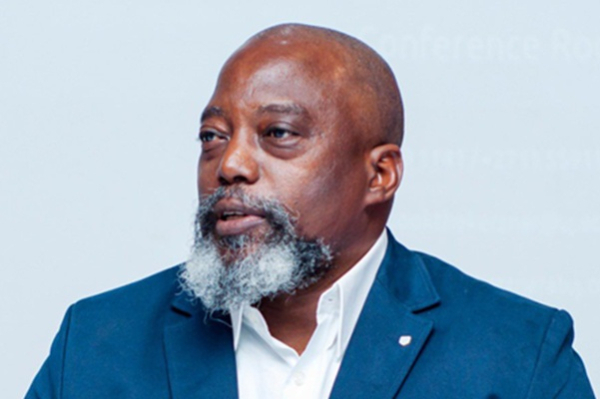
A military prosecutor has requested the death penalty for former DR Congo president Joseph Kabila, who is currently being tried in absentia on charges of treason. Kabila’s political party condemned the trial, calling it “a political show.”
General Lucien Rene Likulia urged the court to sentence Kabila to death, accusing him of war crimes, treason, and inciting an insurrection.
The 53-year-old former leader faces trial for allegedly supporting the Rwanda-backed M23 rebel group.
Kabila has been living outside the Democratic Republic of Congo for the past two years and is accused of plotting to overthrow current President Felix Tshisekedi. Charges against him include homicide, torture, and rape, linked to violence committed by the M23 in eastern Congo.
Likulia argued that the actions of the M23 caused significant harm to the country and that Kabila bore criminal responsibility for these atrocities.
He further accused Kabila of collaborating with Rwanda to orchestrate a coup against Tshisekedi, aiming to overthrow the constitutional government by force, allegedly with help from Corneille Nangaa.
Nangaa, former head of the Congolese electoral commission during the 2018 election won by Tshisekedi, fled the country and later announced the creation of the Congo River Alliance (AFC) a coalition of rebel groups including the M23. Documents seen by AFP describe Kabila as a key initiator of the AFC.
Ferdinand Kambere, deputy general secretary of Kabila’s People’s Party for Reconstruction and Democracy (PPRD), criticized the prosecution as politically motivated.
He said the trial was an attempt to cover up the government’s diplomatic and military failures, arguing the current conditions do not ensure a fair judicial process.
Kabila himself has rejected the proceedings, labeling the courts as “tools of oppression.”
The indictment accuses Kabila of responsibility for atrocities committed by the M23 in the mineral-rich eastern provinces of North and South Kivu.
It details the rebel group’s forcible capture of the city of Goma in January, before a ceasefire was reached in July.
Kabila visited Goma in May, meeting local religious leaders alongside M23 spokesman Lawrence Kanyuka.
President Tshisekedi has accused Kabila of masterminding the armed group’s actions, which have seized large parts of eastern Congo with alleged support from Rwanda.
While Rwanda denies military involvement, UN experts report its army played a crucial role in M23’s offensive.
In July, M23’s executive secretary Benjamin Mbonimpa distanced the group from Kabila in statements made in Goma.
Kabila ruled the DRC from 2001, after the assassination of his father Laurent Kabila, until 2019.
Despite leaving the country in 2023, he continues to wield political influence and has described Tshisekedi’s government as a “dictatorship.”
The DRC lifted a moratorium on the death penalty last year, though no executions have been carried out since then.
For over 30 years, eastern Congo has been plagued by conflict among various armed groups, with tensions rising sharply following the M23’s resurgence in 2021.