

The Office of the Director of Public Prosecutions (ODPP) has intensified its crackdown on money laundering through specialized training aimed at strengthening prosecutors’ ability to secure solid and sustainable convictions.
Secretary Prosecution Services (SPS) Alloys Kemu urged prosecutors to strictly adhere to the ODPP’s Decision to Charge Guidelines to ensure uniformity, consistency and fairness in the administration of justice.
The renewed push comes amid a nationwide anti-money laundering training programme, whose first phase was held last week in Mombasa and Naivasha.
The sessions brought together prosecutors from various stations across the country to sharpen their skills in handling complex financial crimes linked to transnational organised networks.
Speaking during the Mombasa session, Kemu stressed that money laundering prosecutions must be anchored on solid evidence and a clear application of the charging guidelines.
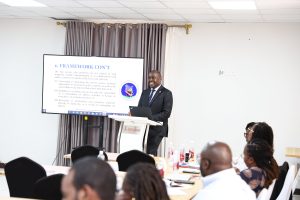
“Money laundering prosecutions must be anchored on solid evidence and a clear application of the Decision to Charge Guidelines. Consistency in our approach is critical if we are to dismantle organised criminal networks,” said Kemu.
He further advised prosecutors to undertake continuous case reviews to ensure only well-supported charges are presented before court.
“Financial crimes require meticulous file analysis, strategic preparation and close collaboration with investigators. We must be deliberate in following the money and presenting cogent evidence that meets the legal threshold,” he added.
The ODPP said the training forms part of a broader institutional strategy to strengthen its response to complex financial crimes that often underpin corruption, wildlife trafficking, drug smuggling and other organised criminal enterprises.
In Naivasha, Senior Deputy Director of Public Prosecutions Vincent Monda highlighted emerging trends used by criminals to conceal and integrate illicit proceeds into the legitimate economy.
He warned that offenders are increasingly exploiting technological innovations and cross-border financial systems to evade detection.
The sessions covered the three key stages of money laundering — placement, layering and integration — and examined evidentiary standards required to sustain charges, including primary, secondary and electronic evidence.
Asset forfeiture was underscored as a critical tool in disrupting criminal enterprises by targeting proceeds of crime.
Alex Akula, Head of the Money Laundering Division, said financial investigations must now take centre stage in combating organised crime.
“We can no longer treat money laundering as an afterthought. Every serious crime has a financial trail, and prosecutors must pursue the proceeds alongside the predicate offence,” said Akula. “When we successfully trace, freeze and recover illicit assets, we significantly weaken criminal networks and protect the integrity of Kenya’s financial system.”
Kenya remains on the grey list of the Financial Action Task Force (FATF), an international watchdog that monitors countries’ efforts to combat money laundering and terrorism financing.
The grey listing signals gaps in financial oversight and enforcement systems that could be exploited by criminals to move illicit funds, increasing pressure on authorities to demonstrate effective reforms and enforcement.