
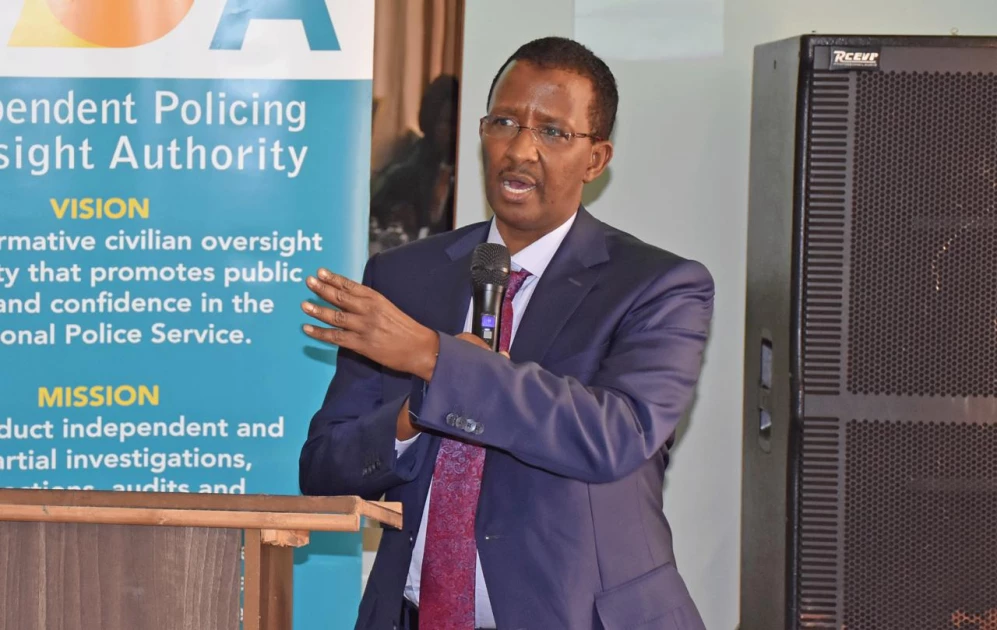
The Independent Policing Oversight Authority (IPOA) could soon have its mandate expanded to cover other State agencies whose officers are authorised to carry firearms, including prison warders, Kenya Wildlife Service (KWS) rangers, Kenya Forest Service (KFS) officers and police reservists.
The proposal emerged during the National Assembly Departmental Committee on Administration and Internal Security’s approval hearing of Dr. Duncan Ojwang Oburu, who has been nominated to chair IPOA board.
Responding to questions from Suna West MP Peter Masara on whether IPOA should be empowered to oversee other armed agencies, Dr. Ojwang backed the proposed reforms saying civilian oversight should extend to institutions whose officers exercise coercive powers or handle firearms.
“There is a Bill already, I think, in the Senate to extend their power to regulate Kenya Forest Services, Kenya Wildlife Services,” Dr Ojwang told the committee.
He said the Constitution’s principle that people entrusted with firearms must be subject to civilian oversight made the proposed expansion “long overdue”.
“The whole principle of the Constitution for the people handling guns … is that they must be oversighted on behalf of Kenyans,” he said.
The nominee said the expansion would, however, require IPOA to receive additional resources and personnel to enable it effectively discharge the wider mandate.
The proposal gained support from Narok West MP Hon. Gabriel Tongoyo, who pointed to previous incidents involving armed officers outside the National Police Service.
Hon. Tongoyo cited a case in Turkana in which KWS rangers were accused of killing fishermen saying Parliament had previously raised the matter and that there had been attempts to expand IPOA’s oversight to such institutions.
Dr. Ojwang argued that extending oversight to the prison service was particularly logical because IPOA already deals with police operations and detention facilities.
“It is an oxymoron to regulate the police services in the street and look at the operation and the detention centres but when now they are fully detained in the incarceration, then IPOA is told to leave,” he said.
He said the proposed changes would require amendments to the law and possibly a change of IPOA’s name to reflect its broader mandate.
“The name will change, but I think it will not require a lot because the principles are already well laid in the Act,” Dr Ojwang said.
The proposed expansion comes amid growing concerns over the use of firearms by State officers and demands for stronger civilian accountability mechanisms.
Dr. Ojwang said the proposed reforms should not be viewed as an attempt to undermine armed agencies but as a way of ensuring that the use of State power remains subject to accountability and constitutional safeguards.
He said IPOA’s role should be to protect citizens and ensure officers entrusted with policing and other coercive powers operate professionally, respect human rights and remain accountable.
The nominee also called for IPOA to be given additional powers and resources, including consideration of powers to make arrests arguing that the authority currently faces difficulties when it has to rely on the same National Police Service whose officers it may be investigating.
“IPOA, in terms of legal reform, most of the institutions have asked on how to cooperate strongly with DPP because IPOA is being blamed … they don’t have direct power. They can recommend and keep recommending and reviewing with the DPP,” he told MPs.
Dr. Ojwang said the authority’s current capacity was inadequate even for its existing mandate.
He told MPs that IPOA has an approved staff establishment of about 1,300 but currently has only around 300 employees, representing roughly a quarter of its required capacity.
He said expanding the authority’s jurisdiction without increasing its resources would make it difficult for IPOA to effectively investigate complaints and monitor armed agencies across the country.
The proposed reforms would therefore require Parliament to consider both the legal framework governing IPOA and the financial implications of giving the authority responsibility over additional armed services.
Dr. Ojwang also said IPOA should embrace technology to improve investigations and oversight, including digitising case files, occurrence book records and firearm-control systems.
He backed the use of body cameras by police officers and installation of functional CCTV cameras in police stations, saying greater visibility would strengthen accountability and help prevent abuses in custody.
The nominee said civilian oversight remained essential because the authority was intended to serve as “the eye of Kenyans” and ensure that those entrusted with policing and other coercive powers remain accountable to citizens.
His proposals come as Parliament considers reforms aimed at strengthening IPOA ahead of the 2027 General Election, when scrutiny of the conduct of security agencies is expected to intensify.
Dr Ojwang said any expanded mandate must be accompanied by adequate funding, personnel and institutional stability, warning that frequent turnover of senior staff could weaken IPOA’s effectiveness.
He told MPs that institutional memory was particularly important at a specialised oversight body and called for measures to improve staff security of tenure and welfare.


