
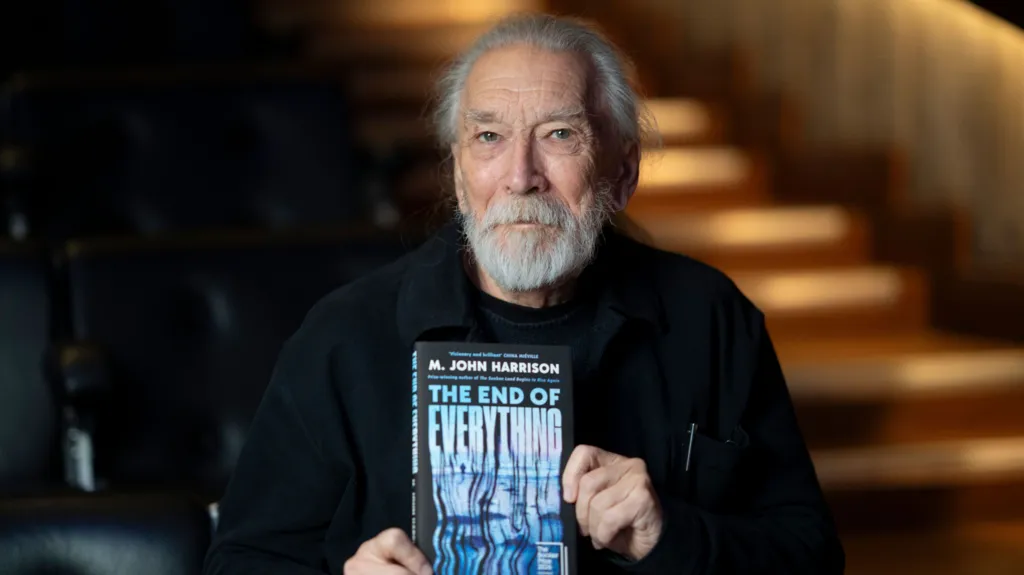
British author M John Harrison has become the oldest-ever winner of the Booker Prize after receiving the prestigious literary award for his post-apocalyptic novel The End of Everything.
Harrison, 81, was announced as the winner of the £50,000 (approximately Sh8.5 million) prize at a ceremony in London on Monday, November 9, 2026.
The author, who has built a cult following over a career spanning six decades, surpassed Margaret Atwood to become the oldest person to win the literary award.
The End of Everything is set in the aftermath of a mysterious catastrophe that causes British society as it is known to collapse.
The novel has divided readers, with critics describing it as both “bleak but brilliant” and “dreamlike and baffling”.
Dame Mary Beard, who chaired this year’s Booker Prize judging panel, praised the novel despite acknowledging its challenging nature.
“It’s a challenging read, but some of the best fiction is challenging,” she said.
Beard added that the book “turns you upside down, raises a wry smile – and surprisingly, given the subject matter, leaves you with a twinge of optimism”.
Harrison began writing in the 1960s and has published 13 novels, five collections of short stories and an “anti-memoir”.
Although he dislikes being associated with labels such as science fiction and fantasy, he has been described as “the titan of literary science fiction”.
Booker Prize chief executive Gaby Wood said Harrison was the first winner to emerge from the established science fiction world.
“He is a genuinely original thinker, a genre-defying writer who takes ideas seriously,” Wood said.
“Though very unsettling, The End of Everything is not in fact a strange book. It’s a realist book about a strange world, populated by desperate, unmoored characters.”
Novel explores life after unexplained catastrophe
The story follows a man and his aunt as they struggle to survive along the south-east English coast following an unexplained disaster and the arrival of mysterious alien beings.
Harrison deliberately provides limited explanations about the events leading to the catastrophe, allowing readers to experience the same uncertainty and confusion as the characters.
“The End of Everything is about trying to live as if nothing has gone wrong. It’s a disaster story in which the disaster is the failure to comprehend,” he said.
He added: “I’ve passed on to the reader some of the puzzlement and confusion of the characters in the book as they face a future with the alien.”
The approach has attracted mixed reactions from literary critics.
The Guardian praised the novel but cautioned that “it won’t be for everyone”, while the New York Times observed that understanding the conditions of the fictional world’s collapse becomes increasingly difficult as the story progresses.
The Literary Review described the book as “a work of uncanny beauty, tender and terrifying in equal parts”, while a Telegraph critic said reading it felt more like dreaming than following a conventional story.
Another Telegraph review described the novel as “ultimately, in both skill and humour, a cut above” the other shortlisted works.
The publication also noted its relevance to contemporary anxieties about artificial intelligence and government warnings about emergency preparedness.
Speaking on BBC Radio 4’s Today programme on Tuesday, Harrison said he wanted to satirise the constant flow of information people receive without necessarily having the tools to understand or critically analyse it.
He explained that the novel was built around a disaster caused by the failure to explain and understand the world.
Other novels shortlisted for the Booker Prize
The Booker Prize is awarded annually to the best novel written in English and published in the United Kingdom or Ireland during the qualifying period. Established in 1969, it is among the most prestigious literary awards.
Harrison emerged victorious from a shortlist of six authors announced in September.
The other shortlisted books were The Disappearers by Marlon James, Black Bag by Luke Kennard, May We Feed the King by Rebecca Perry, The Things We Never Say by Elizabeth Strout, and John of John by Douglas Stuart.
When the shortlist was announced, Beard described the process of selecting the final six novels as, “to put it mildly, hard work”.
Fellow judge and US novelist Patricia Lockwood said she had been “tossing books across the room” during the judging sessions, while poet Raymond Antrobus described the selection process as “a tussle”.
The other members of the judging panel were Pulp frontman Jarvis Cocker and journalist, editor and critic Rebecca Liu.
Speaking after the final judging session on Monday, Beard said the panel had engaged in extensive debate before reaching its decision.
“There was a lot of discussion, disagreement and debate. But nobody stomped off,” she told reporters.
In a statement, Beard said the judges had spent an entire day discussing the six shortlisted novels before unanimously agreeing to award the prize to Harrison.

If you like our work, you can buy us a soda
Buy us a soda 🥤


