

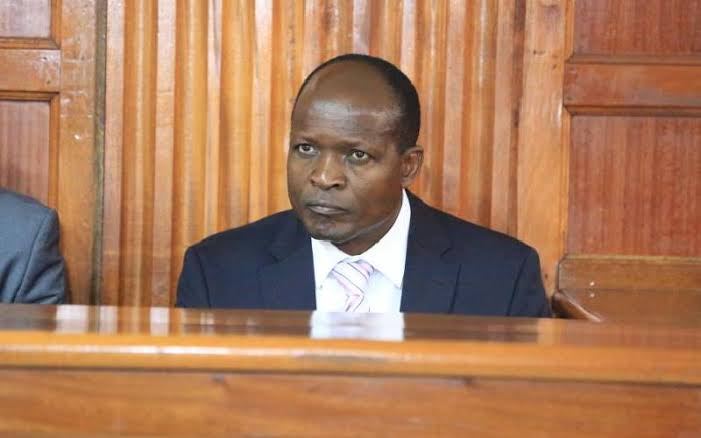
Former Migori Governor Okoth Obado has been sentenced to 25 years in prison for the murder of Rongo University student Sharon Otieno, bringing a major development in one of Kenya’s most closely followed criminal cases.
The sentence was delivered on Friday, November 27, 2026, by High Court Judge Cecilia Wairimu Githua at the Milimani Law Courts in Nairobi.
Obado was sentenced alongside two former associates who were also found guilty of participating in the 2018 murder.
His former personal assistant, Michael Juma Oyamo, received a 25-year prison sentence, while former Migori County Clerk Caspal Ajwang Obiero was handed 18 years behind bars.
The court further directed that the period the three convicts had already spent in lawful custody be deducted from their respective sentences.
Judge Rejects Pleas for Leniency
In her sentencing decision, Justice Githua maintained that the circumstances surrounding Sharon’s murder were too serious to warrant non-custodial sentences.
The judge observed that the crime involved planning, coordination and the participation of individuals who allegedly played different roles in facilitating the killing.
Obado was described as the principal architect of the operation, with the court finding that he provided the motive, instigation and financial resources behind the plot.
Oyamo was found to have facilitated the execution of the plan, while Obiero played a logistical role and helped conceal aspects of the crime.
The judge ruled that the aggravating circumstances outweighed the mitigating factors presented by the defence teams.
Obado’s lawyers had asked the court to consider a non-custodial sentence, proposing a three-year term while citing his previous record, health concerns and reconciliation efforts between the two families.
However, the court maintained that the seriousness of the offence demanded a custodial sentence.
Sharon Otieno’s Family Had Appealed for Leniency
One of the most emotional aspects of the sentencing proceedings was the position taken by Sharon’s parents, who surprised many Kenyans by asking the court to consider leniency for the former governor.
Sharon’s mother, Melida Auma, told the court that the family had forgiven Obado and did not want him to receive the death penalty or life imprisonment.
She argued that Sharon had left behind three children who needed financial and parental support.
The family hoped that a non-custodial sentence would allow Obado to honour his commitments towards the children and help provide for their future.
However, the judge maintained that financial support for the children could not be used as a reason to avoid appropriate punishment for a serious criminal offence.
The court also declined to make a compensation or restitution order, citing insufficient evidence to establish the extent of the losses suffered by the family.
How the Sharon Otieno Murder Case Unfolded
Sharon was a 26-year-old Rongo University student whose murder in September 2018 attracted widespread public attention.
She was seven months pregnant at the time of her death.
The student was reported missing after being abducted on September 3, 2018. Her body was discovered the following day near Kodera Forest in Homa Bay County.
Investigations into her death eventually placed Obado, Oyamo and Obiero at the centre of a criminal case that would take several years to conclude.
The former governor had been linked to Sharon through their relationship, with forensic evidence presented during the trial indicating a 99.99 per cent probability that he was the father of her unborn child.
The prosecution argued that the murder was connected to the circumstances surrounding their relationship and the pregnancy.
During the lengthy proceedings, the prosecution presented dozens of witnesses to establish the alleged roles played by the three accused persons.
Court Convicted Obado and Two Former Associates in July
On July 23, 2026, Justice Githua found Obado, Oyamo and Obiero guilty of murdering Sharon after determining that the prosecution had proved its case beyond reasonable doubt.
The conviction marked a major breakthrough in a case that had remained in the Kenyan justice system for nearly eight years.
Following the verdict, the court cancelled their previous bond terms and ordered that they remain in custody as they awaited sentencing.
The prosecution had pushed for the harshest possible punishment, arguing that the murder was planned and that each convict had a distinct responsibility in the events leading to Sharon’s death.
The defence teams, on the other hand, sought leniency, with Obado’s lawyers relying heavily on reconciliation efforts and the family’s appeal for mercy.
A Major Turning Point for Sharon’s Family
Friday’s sentencing marks a significant chapter in the long pursuit of justice for Sharon, whose death sparked national conversations about gender-based violence, abuse of power and accountability among public officials.
The case also attracted attention because of Obado’s political position at the time. He was serving as Migori governor when the murder occurred.
For Sharon’s family, the conclusion of the sentencing proceedings brings an important milestone after years of court appearances, investigations and emotional uncertainty.
Although her parents had expressed forgiveness towards Obado and appealed for leniency, the court ultimately maintained that the punishment had to reflect the seriousness of the crime.
The sentences handed to the three men now bring another major development in a case that has remained in the public spotlight since 2018.
FOLLOW NAIROBI NEWS ON FACEBOOK

If you like our work, you can buy us a soda
Buy us a soda 🥤


