
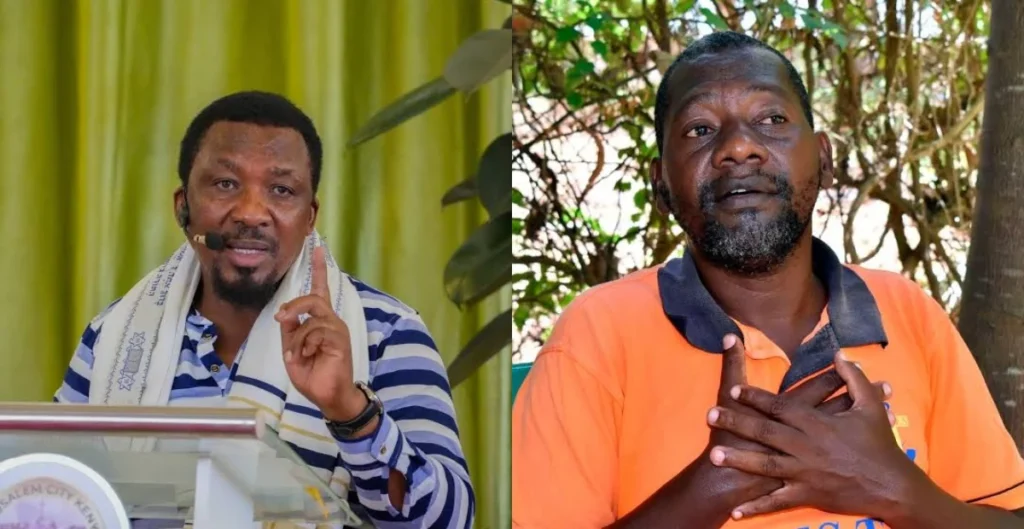
Pastor James Ng’ang’a has reacted to the 200-year prison sentence handed to controversial preacher Paul Mackenzie over the Shakahola tragedy, delivering a blunt message about the consequences of misleading people in the name of religion.
The founder of Neno Evangelism Centre did not mince his words while addressing Mackenzie’s sentencing, questioning his religious teachings and expressing disbelief at how he allegedly convinced followers to starve themselves to death in preparation for meeting Jesus.
During his sermon, Ng’ang’a suggested that Mackenzie deserved an even harsher punishment, openly questioning the circumstances surrounding the deaths of his followers.
“Sijui Mackenzie amefungwa 200. Hata hapo wangemhukumu kunyongwa tu aende,” he said.
The outspoken preacher went on to question the religious justification behind the teachings that allegedly led to the deaths of hundreds of people in Kilifi County.
“Anatumia jina la Yesu. Yesu gani huyo? Yesu gani huyo watu wafunge wakufe waende mbinguni?” Ng’ang’a posed.
He appeared particularly disturbed by the idea of using Christianity to persuade people to undertake dangerous fasting practices, arguing that religious leadership should not involve putting followers’ lives at risk.
Ng’ang’a also made a rather unexpected comparison between himself and Mackenzie, joking about the possibility of facing a lengthy prison sentence if he ever found himself on the wrong side of the law.
“Hii dunia ina mambo mingi kweli. Sijui yangu nitafungwa ngapi,” he remarked.
The preacher, who is in his seventies, further joked about his age, suggesting that even a lengthy prison sentence would not make much difference to him.
“Mi 73, hata ukanifunga hiyo mi nitakuwa tu niko nyumbani tu,” he added.
In another light-hearted moment, Ng’ang’a imagined himself continuing his ministry even behind bars, suggesting that fellow inmates would have an interesting experience if he ended up in prison.
He also distinguished himself from Mackenzie, referring to himself as the chief general.
However, his most striking message was directed at religious leaders whom he accused of misleading their followers.
Ng’ang’a warned those who allegedly exploit religion for personal gain that they would eventually face the consequences of their actions.
“Utavuna kule ulikopanda. Waongo, mwache uongo. Me I don’t support dramas. Manabii wa uongo,” he declared.
His remarks come at a time when the Shakahola tragedy continues to raise serious questions about religious extremism, the regulation of religious institutions and the responsibility of spiritual leaders in Kenya.
Mackenzie, the founder of Good News International Church, was sentenced to 200 years in prison on November 6, 2026, after being convicted in connection with the deaths of 191 people.
High Court Judge Diana Kavedza-Mochache delivered the sentence at the Mombasa Law Courts, imposing two consecutive 100-year terms.
One sentence related to 183 counts of murder by starvation, while the other covered eight counts involving the direct killing of children.
The Shakahola tragedy came to national and international attention in 2023 after authorities discovered mass graves in Shakahola Forest in Kilifi County.
Investigations revealed that followers had allegedly been encouraged to undertake extreme fasting practices in preparation for meeting Jesus.
The operation eventually resulted in the recovery of more than 400 bodies, making the incident one of the darkest chapters in Kenya’s recent history.
The court’s decision was widely viewed as an important step towards accountability for the victims and their families.
Beyond the prison sentences, the court also directed the government to support survivors and children affected by the tragedy through education, healthcare, counselling and economic assistance.
The case has reignited conversations about the need for stronger oversight of religious organisations while protecting the constitutional freedom of worship enjoyed by Kenyans.
Ng’ang’a’s reaction has now added another voice to the debate, with his blunt remarks drawing attention to the responsibility that comes with religious leadership.
His closing statement, “Utavuna ulichopanda,” captured the central message of his reaction: that people, including religious leaders, must ultimately take responsibility for the consequences of their actions.
FOLLOW NAIROBI NEWS ON FACEBOOK

If you like our work, you can buy us a soda
Buy us a soda 🥤


