

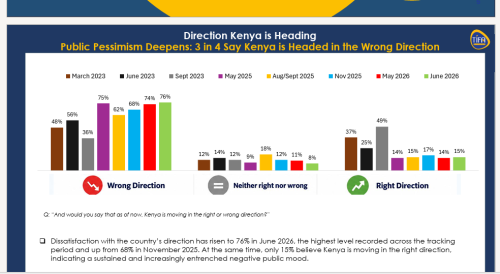
President William Ruto’s political fortunes have come under renewed scrutiny after a new TIFA Research survey revealed that 76% of Kenyans believe the country is heading in the wrong direction, raising fresh questions about the government’s standing ahead of the 2027 General Election.
The survey, released on Wednesday, September 9, paints a difficult picture of public sentiment, with only 14% of respondents saying Kenya is moving in the right direction.
The findings could provide ammunition for Ruto’s political opponents as parties and presidential hopefuls increasingly position themselves for the 2027 contest.
Public mood turns increasingly gloomy
According to the poll, public optimism about Kenya’s trajectory has deteriorated considerably over the past several years.
TIFA has been tracking Kenyans’ views on the country’s direction since March 2023.
The most positive assessment was recorded in September 2023, when 49% of respondents believed Kenya was moving in the right direction.
However, that optimism has since declined sharply.
The latest 76% “wrong direction” figure is among the highest recorded by TIFA, matching the level reported in June 2026.
The organisation also recorded similarly low levels of optimism in May 2025 and May 2026, when only 14% of respondents believed the country was moving in the right direction.
The numbers suggest that dissatisfaction is not simply a short-term political reaction but part of a broader trend that has persisted during Ruto’s presidency.
Mt Kenya, Nairobi record strongest pessimism
The survey also exposed significant regional differences in how Kenyans view the country’s trajectory.
Mt Kenya recorded the highest level of pessimism, with 90% of respondents saying Kenya was moving in the wrong direction.
Nairobi followed at 89%, while Lower Eastern and South Rift recorded 83% and 82%, respectively.
The more optimistic regions still did not produce an outright majority supporting the country’s direction.
Northern Rift recorded the highest positive assessment at 38%, followed by Central Rift at 24%.
The regional figures could become politically significant as the 2027 election approaches, particularly given the importance of coalition-building and regional voting blocs in presidential contests.
Cost of living emerges as a major political headache
Behind the numbers is an increasingly important economic dimension.
TIFA’s findings indicate a strong relationship between how Kenyans perceive their personal financial circumstances and how they assess the country as a whole.
Among respondents who believed Kenya was heading in the wrong direction, 75% said their economic situation had deteriorated since 2022.
Only 7% of those holding the negative view said their financial circumstances had improved.
By comparison, 39% of respondents who believed Kenya was moving in the right direction said their personal economic situation had improved.
The figures underline why issues such as household expenses, employment, taxation and disposable income could remain central to the political debate ahead of 2027.
TIFA’s more recent research has similarly pointed to persistent economic pressure.
An August 2026 survey of Nairobi residents found that 81% of households were experiencing economic pressure, with rising costs of essentials, including transport, fuel, food and education, identified as the biggest challenge by 62% of respondents.
Ruto still leads presidential race despite gloomy mood
Interestingly, the negative assessment of the country’s direction does not automatically translate into overwhelming support for a particular opposition candidate.
TIFA’s June 2026 national survey showed President Ruto leading the presidential preference race with 24%, followed by Edwin Sifuna at 15%, Fred Matiang’i at 14% and Kalonzo Musyoka at 13%.
Rigathi Gachagua had 7%, while 20% of respondents remained undecided.
This presents an intriguing contradiction for the opposition: while dissatisfaction with the country’s direction is high, anti-Ruto sentiment remains fragmented among several political figures.
The same TIFA survey found that 28% of Kenyans did not identify with any political party, suggesting that a substantial section of the electorate remains politically fluid.
ODM had 20% party support, followed by UDA at 17%, DCP at 12%, Jubilee at 10% and Wiper at 7%.
2027 could therefore be a battle for dissatisfied voters
The latest findings may intensify the political scramble for voters who are unhappy with the direction of the country but have not yet settled on an alternative presidential candidate.
Ruto’s administration still has time to attempt to change public perceptions before the next election, while opposition politicians face the equally difficult task of converting dissatisfaction into a coherent political alternative.
TIFA’s research shows that opinion on the Broad-Based Government is also divided.
In its June survey, 52% opposed the arrangement, while 30% supported it, with the remainder either undecided or unaware of the arrangement.
The poll therefore presents a complicated picture for the president.
On one hand, Ruto remains individually ahead of his potential challengers in TIFA’s presidential preference numbers.
On the other, a large majority of Kenyans currently express dissatisfaction with the country’s trajectory.
With the 2027 election approaching, the central political question may ultimately be whether Ruto can turn economic and governance concerns around or whether the widespread sense that Kenya is heading in the wrong direction will translate into a decisive political backlash at the ballot box.
For now, the TIFA numbers provide a stark warning: being ahead of fragmented opponents is not the same thing as enjoying broad satisfaction with the direction of the country.
FOLLOW NAIROBI NEWS ON FACEBOOK

If you like our work, you can buy us a soda
Buy us a soda 🥤


