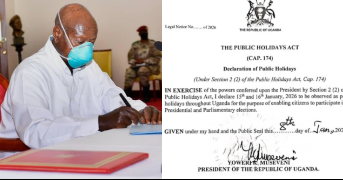
Ugandan President Yoweri Kaguta Museveni has declared January 15 and 16, 2026, as public holidays to allow citizens to participate in the upcoming presidential and parliamentary elections scheduled for next week.
The declaration was made through a Legal Notice issued under the Public Holidays Act, Cap. 174, and officially gazetted by the government.
According to the notice, the two-day holiday is intended to give voters ample time to travel, line up, and cast their ballots without interference from work obligations.
The public holidays will be observed nationwide and will apply to both public and private institutions, as Uganda prepares for what is expected to be a highly scrutinized electoral process.
President Museveni, who has ruled the country since 1986, is seeking another term in office. The elections will also determine the composition of Parliament.
A total of 21.6 million registered voters are expected to take part in three separate polls: the presidential election, the election of 353 constituency Members of Parliament, and the selection of 146 district women representatives.
The presidential race is primarily contested between Museveni and opposition leader Bobi Wine, marking their second electoral face-off.
In the 2021 election, Museveni, now 81, secured 58 percent of the vote against Bobi Wine’s 35 percent. That election was marred by allegations of vote rigging and a heavy crackdown on opposition supporters.
Under Ugandan law, a presidential candidate must secure at least 50 percent plus one vote to avoid a runoff in the country’s two-round electoral system.
However, concerns about the credibility and transparency of the electoral process persist among sections of the population.
Uganda’s elections come nearly four months after neighboring Tanzania held a controversial general election that was followed by post-election unrest.
Tanzanian President Samia Suluhu was declared the winner with 31.9 million votes, representing 97.66 percent of the total votes cast, according to the country’s Electoral Commission.
That election drew criticism from opposition groups and the international community, particularly due to the imprisonment of main opposition candidate Tundu Lissu during the campaign and voting period, and the disqualification of another key opposition figure.