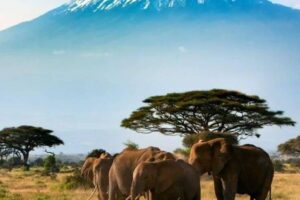
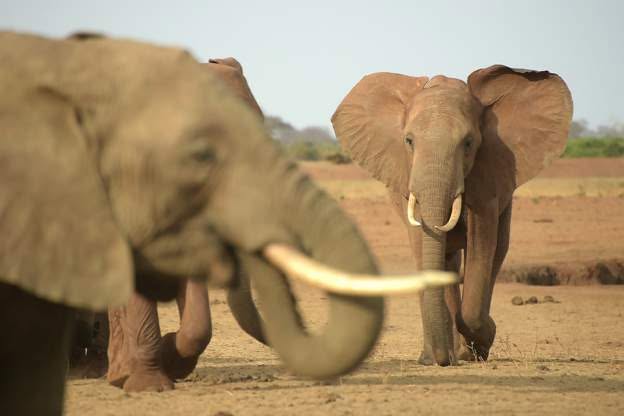
The Kenya Wildlife Service relocated two rogue elephants from the Kamboo area in Makindu, Makueni County following increased incidents of fatal attacks in the latest series of human-wildlife conflict.
The animals were Tuesday relocated to Tsavo West National Park in an operation by a team of KWS personnel.
Officials said the operation ended without an incident being reported.
The locals had threatened to hunt and kill the animals. They are believed to have strayed from the same park and had made life in the area unbearable. The elephants were linked to at least three deaths.
On June 15, a nine-month-old baby was killed and her mother injured after they were attacked by a stray elephant in Kiboko area, Makueni County.
The incident occurred on the morning as 29-year-old woman was heading to work at a farm. She was accompanied by her nine-month-old daughter.
According to police, a team and Kenya Wildlife Service (KWS) personnel visited the scene and confirmed the incident.
By the time officers arrived, well-wishers had already rushed the woman and another child to Makindu Sub-County Hospital for treatment.
Police said the elephant attack claimed the life of the baby. Efforts to retrieve the child’s body were initially hampered by angry residents who protested at the scene.
However, after intervention by the area chief and the Sub-County Security Team, calm was restored and officers were able to proceed with their work.
Crime scene personnel from Makindu documented the scene before the body was moved to Makindu Sub-County Hospital Mortuary pending further procedures.
The incident highlights the continuing challenge of human-wildlife conflict in areas bordering wildlife migratory routes, particularly around the Kiboko region.
Authorities are expected to investigate the circumstances of the attack and engage local communities on measures to reduce similar incidents.
The government has introduced a compensation scheme for such victims as part of ways of mitigating the conflict.
In May 2025, Kenya introduced the third phase of its Human–Wildlife Conflict Compensation Programme, an initiative aimed at addressing these incidents and supporting affected families.
During its launch at Meru National Park, President William Ruto unveiled the innovative Wildlife Conservation Card, a new tool designed to help fund conservation efforts.
“Compensation is justice, but prevention is progress,” Ruto said, emphasizing the need for long-term solutions that benefit both people and wildlife.
“Through the Conservation Card, fencing, and community‑led tourism, we are turning conflict into opportunity,” he added.
Developed in partnership with KCB Bank, the Wildlife Conservation Card is available in three tiers—Platinum (Elephant), Gold (Lion), and Silver (Cheetah).
A portion of every transaction made with the card (Sh10, Sh5, and Sh3, respectively) goes directly to the Wildlife Conservation Trust Fund.
The initiative aims to enable Kenyans and international supporters to contribute to wildlife conservation while fostering economic benefits for local communities.
With this new approach, Kenya hopes to build a future where humans and wildlife can coexist more safely and sustainably.
Man found dead in house after returning home intoxicated in Tharaka Nithi