
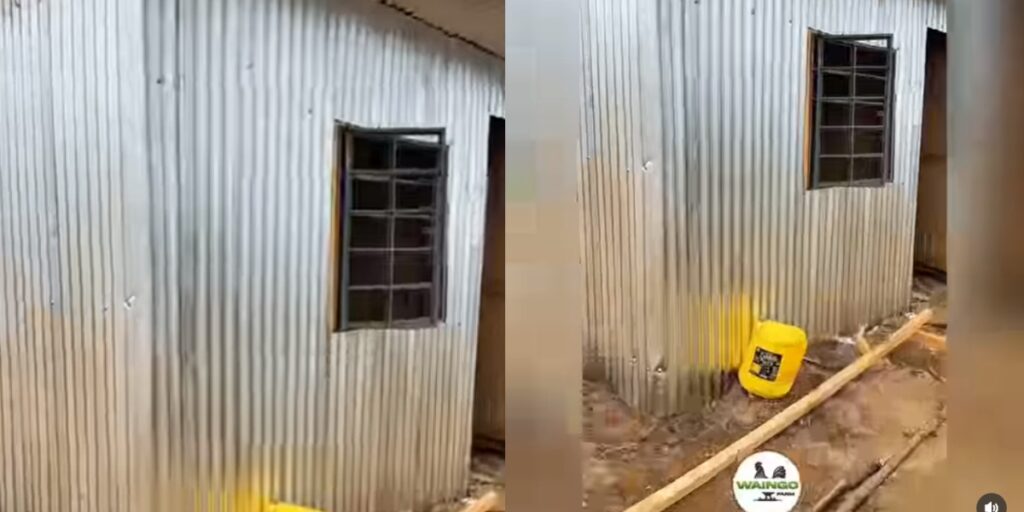
Gospel musician Guardian Angel has once again found himself at the centre of an online debate after claims emerged that he has ventured into the affordable housing business, with mabati rental units reportedly going for as little as Sh5,000 per month.
The development has sparked mixed reactions among Kenyans online, with some praising the singer for investing in property that could provide affordable accommodation, while others have questioned the quality, size and suitability of the mabati structures for tenants.
The reported mabati rental project comes at a time when Guardian Angel has increasingly been showcasing his entrepreneurial side beyond music.
In recent months, the gospel artiste has shared details of his investments, including his expansive 20-acre Waingo Farm in Machakos County, where he has been developing agricultural projects involving fish farming, azolla and livestock.

Guardian Angel has previously attracted attention for documenting his farming activities, with several social-media users describing him as hardworking and entrepreneurial.
His latest reported move into affordable mabati housing has therefore generated another wave of discussion, particularly because of the alleged Sh5,000 monthly rent.
Affordable housing or too much for mabati houses?
The biggest point of contention among netizens has been whether Sh5,000 is reasonable for a structure predominantly made from iron sheets.
While some Kenyans see the project as a practical response to the country’s housing challenges, others have argued that tenants paying rent should be guaranteed decent and safe living conditions regardless of the material used to construct the houses.
The debate comes against the backdrop of Kenya’s continuing demand for affordable rental accommodation.
Property platforms currently list thousands of rental properties across the country, ranging from bedsitters and single rooms to apartments and larger houses, with prices varying considerably depending on location and amenities.
For many low-income households, however, affordability remains a major consideration, particularly in urban and peri-urban areas where conventional apartments can command considerably higher monthly rents.
Netizens react
The alleged project quickly became a talking point online, with some users expressing disbelief at the idea of paying Sh5,000 for mabati accommodation.
Among the reactions were comments along the lines of:
“Sh5,000 for mabati? Hii Kenya imekuwa expensive sana.”
Another netizen questioned whether the structures had basic amenities, asking:
“At least tell us kama kuna toilet, water and electricity ama ni mabati tu.”
A third user sarcastically wrote:
“Celebrity ameingia landlord business sasa. Sh5k ya mabati?”
Others, however, defended the singer, arguing that the project should be judged on affordability and functionality rather than the material used to construct the houses.
“If the houses are safe, clean and have water and electricity, what’s wrong with Sh5,000?”
Another added:
“People are complaining about mabati but forget there are Kenyans who cannot afford Sh10k rent. Affordable housing is still housing.”
Some social-media users also praised Guardian Angel for diversifying his income instead of depending entirely on his music career.
Guardian Angel’s growing investment profile
Guardian Angel, whose real name is Audiphaxad Omwaka, has increasingly shared glimpses of his investments and business activities with his followers.
His agricultural venture has particularly attracted attention.
In June 2026, reports showed him actively participating in the development of his 20-acre Waingo Farm in Machakos, including work on a fish pond and plans involving azolla for his poultry project.
The musician has also been associated with an increasingly visible entrepreneurial lifestyle, with his farming activities receiving largely positive reactions from his followers.
Earlier coverage of his farm showed him displaying livestock including cows, turkeys and rabbits, with social-media users praising his approach to wealth creation and investment.
The reported rental project would represent another potential expansion of his investment portfolio, this time targeting the mass housing market.
The bigger conversation about cheap rentals
The controversy surrounding the alleged Sh5,000 units also highlights a broader conversation about what constitutes affordable housing in Kenya.
For tenants struggling with high living costs, a low monthly rent can be attractive. But affordability alone does not necessarily guarantee good housing standards.
Tenants generally consider factors such as access to water, electricity, sanitation, security, ventilation, drainage and proximity to workplaces when choosing accommodation.
The question, therefore, is whether the reported units provide these basic amenities alongside the low rental price.
For Guardian Angel, the controversy could ultimately become another chapter in his increasingly public investment journey.
Whether Kenyans will embrace the reported Sh5,000 units or continue questioning the concept remains to be seen, but the debate has once again demonstrated the intense scrutiny celebrities face whenever they venture into business.
For now, however, the specific details of the alleged rental project, including its exact location, number of units, amenities and whether Guardian Angel personally owns and operates the development, would need to be independently confirmed before they can be treated as established facts.
FOLLOW NAIROBI NEWS ON FACEBOOK
If you like our work, you can buy us a soda
Buy us a soda 🥤