
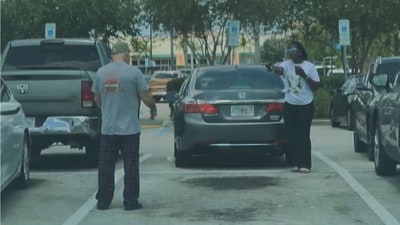
A Florida woman who fatally shot a 62-year-old Army veteran during a heated dispute over a parking space at a Walmart will not face criminal charges, after prosecutors determined that she was protected by the state’s controversial “Stand Your Ground” law.
Melissa Payne shot Bart Diguglielmo once in the abdomen during the confrontation outside a Walmart in North Lauderdale on June 30, 2026.
Despite Diguglielmo being unarmed, prosecutors concluded that video evidence supported Payne’s claim that she reasonably feared an imminent threat of serious bodily harm.
The decision has reignited debate over how far self-defense laws should extend when an argument escalates into a fatal shooting.
Parking dispute turns deadly
According to the Broward County State Attorney’s Office, Payne and Diguglielmo became involved in a dispute after attempting to claim the same parking space at the Walmart on West McNab Road.
The confrontation was extensively documented by surveillance cameras and cellphone footage, meaning investigators were able to reconstruct much of what happened before the shooting.
Prosecutors said Diguglielmo initially left his vehicle and entered the store before returning to the parking lot.
Witnesses reported that he appeared angry and made threats about damaging Payne’s vehicle.
He subsequently parked elsewhere and approached Payne’s vehicle several times.
Payne, who was reportedly accompanied by her niece and an infant, warned Diguglielmo to stay away.
According to the prosecutor’s account, she repeatedly told him not to approach her or her vehicle and warned that she would shoot if he continued coming closer.
The confrontation eventually ended when Payne fired a single shot.
Diguglielmo was struck in the abdomen and transported to a hospital, where he later died from his injuries.
Why prosecutors declined to charge Payne
The Broward County State Attorney’s Office concluded that Payne was entitled to immunity under Florida’s Stand Your Ground law.
Florida law allows a person to use deadly force when they reasonably believe it is necessary to prevent imminent death or great bodily harm to themselves or another person.
The law also removes the duty to retreat when its conditions are satisfied.
A key factor in the case was the extensive video evidence.
Prosecutors said footage showed Diguglielmo repeatedly moving toward Payne and circling around her vehicle, despite her warnings.
While he was not armed, investigators determined that his movements and the circumstances could reasonably have caused Payne to fear serious physical harm.
Florida Assistant State Attorney Stephen Zaccor reportedly concluded that the evidence did not allow prosecutors to disprove Payne’s claim of self-defense.
Under Florida’s legal framework, the state must establish that a defendant’s use of force was not justified when immunity is claimed.

The 2017 amendment to the law further shifted the burden to prosecutors to disprove a self-defense claim by clear and convincing evidence.
In this case, prosecutors determined they could not meet that burden.
Family rejects self-defense explanation
The decision has nevertheless drawn strong opposition from Diguglielmo’s family.
His daughter, Amanda Diguglielmo, expressed disappointment that prosecutors decided against pursuing criminal charges and disputed the conclusion that her father posed an imminent threat.
Her attorney, Melissa Rodriguez, argued that the circumstances did not justify deadly force and maintained that Payne should have faced criminal charges.
Amanda described her father as a devoted family man, father, grandfather and Army veteran, saying his death had left a profound void in the family.
The family’s position highlights one of the central controversies surrounding Stand Your Ground laws: how should the law balance a person’s right to defend themselves against the fact that the other person may have been unarmed?
A controversial law at the centre of the case
Florida’s Stand Your Ground law was enacted in 2005 and has become one of the country’s most closely watched self-defense statutes.
Supporters argue that people should not be legally required to retreat when confronted with a potentially life-threatening situation, particularly when they are lawfully present and reasonably believe they face serious harm.
Critics, however, have long argued that the law can make it difficult to prosecute shootings arising from confrontations that might otherwise have ended without deadly violence.
The Payne case is likely to fuel that debate again because the confrontation reportedly began over something as ordinary as a Walmart parking space before ending with the death of an Army veteran.
For prosecutors, however, the issue was not whether the dispute was trivial or tragic. It was whether the available evidence could establish beyond the required legal threshold that Payne’s decision to fire was not protected self-defense.
Their answer was no.
As a result, Payne will not face criminal prosecution for Diguglielmo’s death, despite the shooting being fatal.
The case now stands as another striking example of how Florida’s Stand Your Ground protections can transform the legal outcome of a deadly confrontation even when the dispute begins with something as mundane as a fight over a parking spot.
FOLLOW NAIROBI NEWS ON FACEBOOK

If you like our work, you can buy us a soda
Buy us a soda 🥤