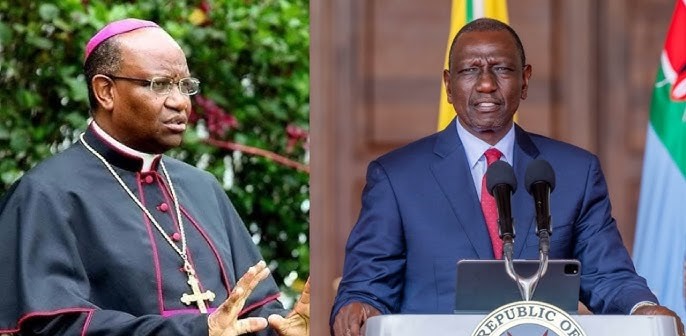
The war of words between President Ruto’s government and the church took a new twist on Monday after the Archdiocese of Nairobi rejected a donation by the president and Nairobi Governor Johnson Sakaja.
The Archdiocese of Nairobi reaffirmed its commitment to the Kenya Conference of Catholic Bishops’ (KCCB) policy on political donations to the Church.
The KCCB, in a statement delivered on November 14, 2024 and read in all churches within the Archdiocese on Sunday, November 17, 2024, emphasized the importance of preserving the Church’s independence and sanctity, as well as the ethical concerns surrounding political contributions.
Archbishop Philip A. Anyolo emphasized the Church’s strong opposition to using its platforms for political gain.
On November 17, 2024, the Archdiocese announced the rejection of several donations made at Soweto Catholic Church, in accordance with KCCB directives and the Public Fundraising Appeals Bill 2024.
Sakaja donated Sh200,000 to the Parish Choir and Parish Missionary Council while Ruto donated Sh600,000 to the same organizations.
Ruto also contributed Sh2 million to the Fathers’ House construction.
The bishops also rejected a Sh3 million pledge for additional construction and a parish bus donation.
“The President’s donation of Sh600,000 to the choir and Sh2 million for the construction of the Fathers’ house will be refunded to the respective donors.
The promised additional Sh3 million for the construction of the Fathers’ house, as well as the donation of a parish bus by the President, are hereby declined,” read part of the statement.
The Archdiocese confirmed that any funds previously received in violation of these directives would be returned to donors.
He urged politicians not to use the pulpit for rhetoric, claiming that such actions jeopardize the sanctity of religious spaces.
While inviting politicians to attend church for spiritual nourishment, Archbishop Anyolo emphasized that they should do so as ordinary Christians rather than using their positions for personal or political gain.
He emphasized that the church should remain a place of worship and community guidance, free of political interference or influence.
The Church emphasized its role as a neutral institution free of external influence, as well as its obligation to reject any contributions that jeopardize its integrity or perpetuate unethical behavior.
The Church urged political leaders to focus on critical national issues such as political squabbles, corruption, human rights violations, broken promises, over taxation, and misplaced priorities.
Leaders were also urged to demonstrate ethical leadership by prioritizing Kenyans’ needs over selfish political goals.
https://nairobinews.co.ke/kenyans-to-know-new-eacc-ceo-in-january-as-search-kicks-off-in-nairobi/

If you like our work, you can buy us a soda
Buy us a soda 🥤