China has extended a financial lifeline to Kenya by providing approximately Sh129 million to strengthen the country’s preparedness and response to potential Ebola outbreaks, as health authorities intensify efforts to prevent further infections following the confirmation of the country’s first imported case.
The funding forms part of a larger Sh259 million grant from the Chinese government, with half of the money allocated to Ebola preparedness and the remaining amount earmarked for drought mitigation.
The assistance comes at a critical moment for Kenya, which confirmed an imported case of Bundibugyo Ebola Virus Disease involving a Kenyan citizen who had been living in the Democratic Republic of Congo (DRC).
The patient died on October 6, 2026, prompting health officials to intensify surveillance, contact tracing and other emergency measures to prevent possible transmission.
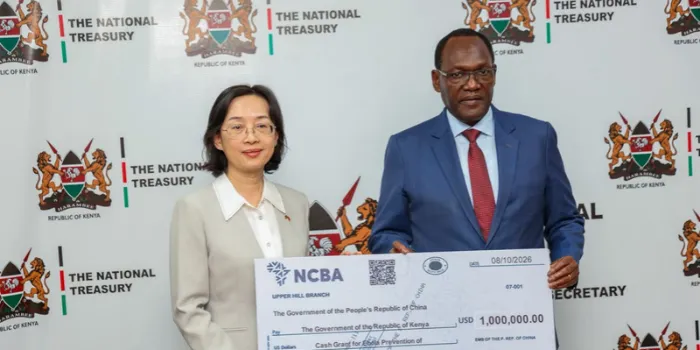
According to the Chinese Embassy in Kenya, the grant was formally handed over at the National Treasury on Thursday, October 8, during a ceremony attended by Chinese Ambassador Guo Haiyan and Treasury Principal Secretary Chris Kiptoo.
The funding is intended to help Kenya strengthen its capacity to detect, prevent and respond to Ebola, particularly in counties identified as having a high risk of exposure.
How China Plans to Support Kenya’s Ebola Response
The Chinese government has allocated USD 1 million, equivalent to approximately Sh129 million, specifically for Ebola preparedness and response.
The money will support the Kenyan government’s efforts to strengthen preparedness infrastructure in counties classified as high-risk and very high-risk areas.
The other USD 1 million will be used to help Kenya address the effects of drought, which continues to pose challenges to livelihoods and food security in vulnerable communities.
The Chinese Embassy said the assistance followed a request from the Kenyan government and was intended to support both epidemic prevention and drought relief.
Ambassador Guo Haiyan reiterated China’s willingness to strengthen development cooperation with Kenya through existing bilateral partnerships and broader cooperation frameworks.
The funding adds to the resources Kenya is mobilising to improve its ability to manage public health emergencies.
Kenya Intensifies Ebola Surveillance After Patient’s Death
The grant arrives as the Ministry of Health steps up measures to contain the risk associated with the imported Ebola case.
In an update issued on October 6, the Ministry of Health confirmed that the patient had travelled from the DRC to Uganda before boarding a Jambojet flight to Nairobi on October 3.
After arriving in Kenya, the patient was taken to Nairobi Hospital, where medical teams isolated and assessed him before laboratory tests confirmed the presence of Bundibugyo Ebola Virus Disease.
The patient subsequently died, raising concerns about possible exposure among people who had interacted with him during his illness and journey.
Health authorities launched contact-tracing operations involving family members, healthcare workers and passengers who travelled on the same flight.
In a subsequent update on October 7, the Ministry reported that 57 contacts had been identified, with efforts underway to locate and monitor those potentially exposed.
The government has also strengthened surveillance at airports and border crossings as part of efforts to detect suspected cases early and prevent further transmission.
According to the Ministry of Health, more than 652,000 travellers had been screened by October 6, while 267 samples had been tested through Kenya’s laboratory network.
The government has also trained approximately 4,971 healthcare workers in Ebola prevention and case management.
These measures are intended to ensure that suspected cases are identified quickly, tested and isolated when necessary.
Government Mobilises Billions for Emergency Response
China’s contribution comes as Kenya seeks additional resources to strengthen its health emergency response systems.
The government has been mobilising substantial funding for Ebola preparedness, including an initial allocation of approximately Sh2.6 billion for emergency interventions, according to reports on the government’s response.
Additional support is also expected from international development partners, including the World Bank and the United States government.
The funds are intended to strengthen disease surveillance, improve laboratory testing, train healthcare personnel, support contact tracing and ensure that essential medical supplies are available when needed.
Kenya’s geographical position and its extensive transport connections with neighbouring countries make surveillance at airports and land borders particularly important.
The country maintains travel and trade links with several states in the region, including Uganda and the DRC, where health authorities have dealt with Ebola-related threats.
Consequently, the ability to identify suspected infections quickly and coordinate information with neighbouring countries remains central to preventing the spread of infectious diseases.
What Is Bundibugyo Ebola Virus Disease?
Bundibugyo Ebola Virus Disease is a form of Ebola caused by the Bundibugyo virus.
Ebola is a severe illness that can cause fever, fatigue, muscle pain, sore throat, vomiting, diarrhoea and, in some cases, bleeding.
The disease can spread through direct contact with the blood or other bodily fluids of an infected person who is symptomatic, as well as through contaminated objects.
However, different Ebola virus species do not respond identically to every treatment or preventive intervention.
Unlike the Zaire ebolavirus species responsible for several major outbreaks, Bundibugyo virus is not covered by the same established vaccine and treatment options specifically developed for Zaire ebolavirus.
This makes early detection, appropriate isolation, infection prevention and control, supportive medical care and effective contact tracing especially important.
Health authorities have therefore urged healthcare workers to maintain strict infection-prevention procedures when assessing suspected cases.
Members of the public have also been encouraged to seek medical attention promptly if they develop concerning symptoms, particularly if they believe they may have been exposed.
Government Urges Kenyans Not to Panic
Despite the confirmed imported case, the Ministry of Health has urged Kenyans to remain vigilant without creating unnecessary alarm.
Health Cabinet Secretary Aden Duale said Kenya was strengthening its preparedness and response systems while emphasising the importance of relying on official information.
The government has identified isolation and treatment facilities to manage suspected and confirmed cases, while additional measures are being implemented at points of entry.
The Ministry has also encouraged the public to practise regular handwashing, avoid contact with the bodily fluids of sick individuals and seek assistance from recognised health facilities when necessary.
Kenyans seeking guidance can contact the Ministry of Health’s toll-free information line on 719.
Health officials continue to emphasise that rapid identification of suspected cases, timely medical assessment and effective monitoring of contacts are essential to preventing further transmission.
China-Kenya Cooperation Extends Beyond Infrastructure
China’s latest financial contribution also highlights the broader relationship between Nairobi and Beijing, which has traditionally focused on infrastructure, trade, investment and development projects.
Over the years, the two countries have pursued cooperation in several sectors, including transport, energy, education and public health.
The latest grant demonstrates how bilateral cooperation can also support emergency interventions when countries face immediate humanitarian and health challenges.
By dividing the assistance between Ebola preparedness and drought mitigation, the Chinese government is addressing two separate challenges confronting Kenya: the threat of infectious disease and the effects of climate-related emergencies.
The drought component is particularly significant for communities facing pressure on water supplies, livestock and agricultural production.
The Ebola allocation, meanwhile, provides additional resources as Kenya works to strengthen surveillance and prevent the imported case from leading to further infections.
What Happens Next?
The immediate priority for Kenyan health authorities is to trace and monitor people who may have been exposed to the confirmed case while maintaining surveillance across the country’s health facilities and points of entry.
The effectiveness of the response will depend on how quickly contacts are identified, whether suspected infections are detected early and how effectively healthcare workers implement infection-prevention measures.
The Chinese grant will provide additional financial support, but continued coordination between the national government, county authorities and international health partners will remain essential.
For now, the government is urging Kenyans to remain informed, follow official public health guidance and avoid spreading unverified information about the disease.
As Kenya strengthens its emergency response, the assistance from China adds to the country’s efforts to prevent a single imported case from developing into a wider public health crisis.
FOLLOW NAIROBI NEWS ON FACEBOOK

If you like our work, you can buy us a soda
Buy us a soda 🥤