
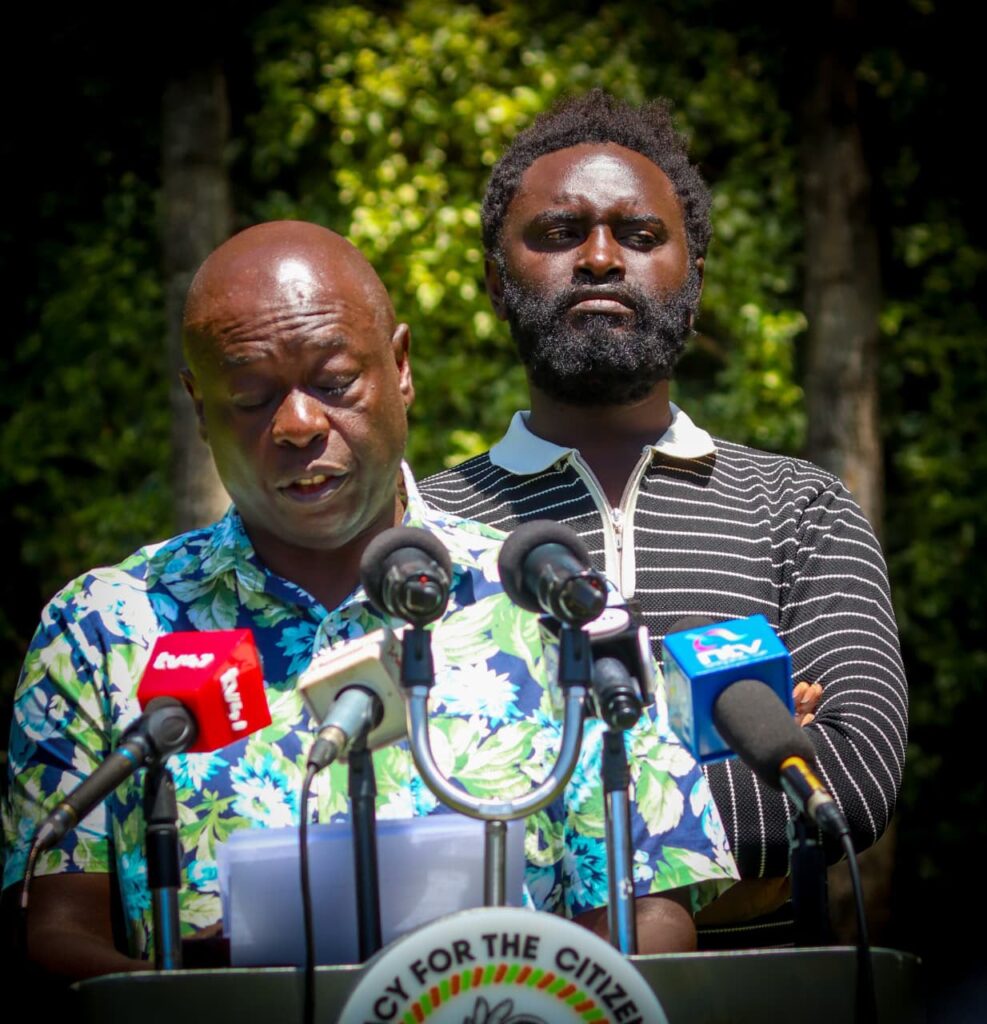
Former Deputy President Rigathi Gachagua alleged a plan to rig the 2027 General Election, claiming South Korean firm Miru Systems Co. Ltd is at the centre of a predetermined procurement process.
He addressed the media on Wednesday ahead of his US trip.
Gachagua accused IEBC Chairman Erastus Edung Ethkon and Vice Chairperson Fahima Araphat Abdallah of orchestrating a sham tender process to award the Integrated Election Management System (IEMS) contract to Miru.
“The tender process and result has already been preconceived and is awaiting rubber stamping,” Gachagua alleged, describing the ongoing procurement as “a mundane public relations exercise to manage other bidders and 55 million Kenyans.”
He alleged that IEBC commissioners fired the procurement manager and installed a replacement, and that both Ethkon and Abdallah have “been paid commissions in advance” to ensure the tender outcome.
There was no immediate comment from the commission.
He further alleged that Interior Principal Secretary Raymond Omolo and Immigration PS Belio Kipsang have held meetings with Miru officials to provide access to Kenya’s voter registration database for “integration purposes.”
Gachagua directly challenged Ethkon’s integrity, referencing his appointment as chairperson and alleging he lives in a Karen home procured for him at Sh200 million.
“You have a choice to make: stand with Kenyans, the 55 million of them, or choose to burn this country,” Gachagua told the IEBC chief.
He also recalled Ethkon’s controversial appointment, stating that Kenyans have long viewed the IEBC as “an appendage of William Ruto”.
According to Gachagua, Miru Systems’ has had a troubled electoral history across multiple jurisdictions.
In the Democratic Republic of Congo’s 2023 elections, election observers reported that up to 45 percent of polling stations experienced equipment malfunctions, potentially excluding around 17 million Congolese voters.
He said that following the disputed elections in 2018 and 2023, the U.S. Treasury Department sanctioned the DRC’s then-election commission president and two deputies for undermining democratic processes.
He also pointed to the Philippines’ 2024 mock elections which used Miru technolog.
He said the trials encountered “fatal flaws,” with human rights organizations rejecting the company’s explanations and citing unresolved security and reliability issues.
Gachagua also referenced Iraq’s Kurdistan Region parliamentary elections in October 2024 where he explained that voting machines in 70 to 75 percent of stations reportedly malfunctioned, failing to properly record and transmit results.
Iraq’s Board of Supreme Audit had raised credibility warnings days before the vote.
The South Korean government publicly distanced itself from Miru following its late delivery of ballot verification kits to Congo in 2018, according to Gachagua’s statement.
Gachagua raised procedural concerns about the IEBC tender (Ref. IEBC/OIT/01/2026-2027), which closed September 1st, 2026.
He alleged that mandatory technical specifications have been “specially crafted around the profile of Miru Systems” rather than being vendor-neutral and performance-based.
Gachagua posed a series of direct challenges to IEBC, asking whether technical specifications were drafted to match Miru’s specific operational history, what market analysis IEBC undertook to establish multiple qualified manufacturers could meet specifications, and how qualification requirements correspond specifically to Miru’s experience.
Gachagua alleged Miru has been instructed to suppress voter registration in regions perceived as opposition strongholds: Western Kenya, Nyanza (excluding Kisii and Nyamira), Mt. Kenya Region, Lower Eastern, Nairobi, Taveta, Lamu, and parts of the Rift Valley.
The most critical allegation concerned data transfer.
“The real mischief of IEBC is to interfere with the voter register during the transfer of data from the Smartmatic KIEMS kits to the Miru Technologies Kits,” Gachagua claimed. “This will cause massive vote rigging and voter suppression in some areas.”
Gachagua alleged that Parliament has deliberately delayed passage of the Elections Amendment Bill 2024, which would require electoral technology suppliers to grant IEBC intellectual property rights and system ownership.
He further alleged that recent ownership changes at De La Rue Kenya Limited, a security printer with capacity to print election materials, are “directly linked to the ongoing electoral fraud” planned for 2027.
The officials mentioned in the statement did not respond to calls.
Nick Daicos net worth, AFL career, brand partnerships and entrepreneurship

If you like our work, you can buy us a soda
Buy us a soda 🥤