
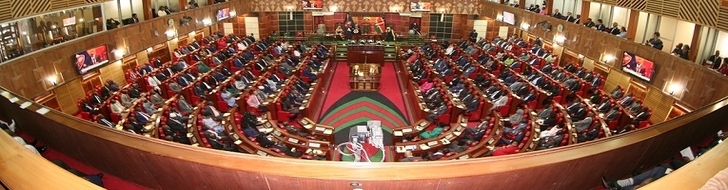
The National Assembly Committee on Education has urged the Ministry of Education to develop clear regulations on student discipline, warning that schools are facing growing challenges in managing unruly learners.
The committee, chaired by Tinderet MP Julius Melly, raised the concerns during an ongoing stakeholders’ engagement on seven education reform Bills, where the State Department for Basic Education, led by Principal Secretary John Ololtuaa, presented its submissions.
Melly said Clause 19 of the Basic Education Bill, 2026, provides extensive protection for learners but does not clearly outline disciplinary measures that schools can take against students who engage in violent behaviour or harm others.
He warned that the absence of clear disciplinary guidelines was making it increasingly difficult for teachers to maintain order and protect themselves and other learners.
“Schools are now ungovernable. Teachers are very unsafe since students can wake up and manhandle a teacher and they cannot do anything since the student is protected by the law. Some students are now even burning fellow students in schools. So, PS, the issue of student discipline is very important and the Ministry must develop very clear regulations,” Melly said.
In response, Ololtuaa told the committee that the Cabinet Secretary for Education would need to develop regulations outlining how schools should handle disciplinary cases, including circumstances under which learners could be suspended.
He referred to Clause 19(2) and (3) of the Bill, which prohibits corporal punishment, torture and cruel, inhuman or degrading treatment of learners, whether physical or psychological.
“Clause 19, subsection 2 and 3 state that, a learner should not be subjected to corporal punishment, torture, or cruel inhuman or degrading treatment or punishment of any manner, whether physical or psychological. So, on issues of discipline the CS must be able to come up with regulations to capture all those aspects,” Ololtuaa said.
Council of Legal Education Chairperson Professor Collins Odote, who accompanied the Principal Secretary, supported the call for clear disciplinary guidelines, saying the existing mechanisms were inadequate.
“On the issue of discipline, there must be concession that what we have now is difficult. The current discipline mechanism is not working and there is need to do more,” Odote said.
The committee also questioned the Ministry’s position on the proposed transfer of the School Equipment Production Unit (SEPU) into a Government-Owned Enterprise under the Basic Education Bill, 2026.
Lawmakers sought clarification on how the Ministry would ensure schools continued accessing affordable learning materials if SEPU was placed outside its direct control.
Ololtuaa told the committee that the decision to transfer the unit followed an Executive Order issued after a Cabinet meeting and that the Ministry was required to implement it.
Meanwhile, the Teachers Service Commission (TSC), led by Acting Chief Executive Officer Evaline Mitei, also appeared before the committee to present its views on the proposed education reforms.
The commission supported Clause 27 of the Basic Education Bill, 2026, which provides for the registration of basic education institutions.
TSC argued that the provision would help ensure that only institutions with registered teachers are issued with registration certificates.
However, while presenting its submissions on the Pre-Service Education and In-Service Training Bill, 2026, the commission opposed provisions contained in Clauses 50, 51 and 52, which deal with savings, transitional arrangements and revocation.
Mitei and her team particularly objected to the proposal to convert Kibabii, Kagumo and Lugari Teachers Training Colleges into branches of the Kenya School of Education.
“The Commission strongly objects converting Kibabii, Kagumo and Lugari TTCs as branches of Kenya School of Education to offer conference facilities. The colleges should be left to independently continue training teachers in the new learning areas introduced by the CBE, so as not to deny the country adequate teaching resource,” Mitei said.
The commission maintained that the three institutions should retain their independence and continue training teachers to meet the country’s requirements under the Competency-Based Education (CBE) system.
Other stakeholders who presented submissions before the committee included the Kenya Medical Training College, the National Treasury, the Ministry of Interior, the Kenya Institute of Special Education, the Higher Education Loans Board and the Technical and Vocational Education and Training Authority.
The committee is scheduled to continue its engagement with stakeholders on Thursday, November 6, 2026, as lawmakers consider proposals contained in the seven education reform Bills.

If you like our work, you can buy us a soda
Buy us a soda 🥤