
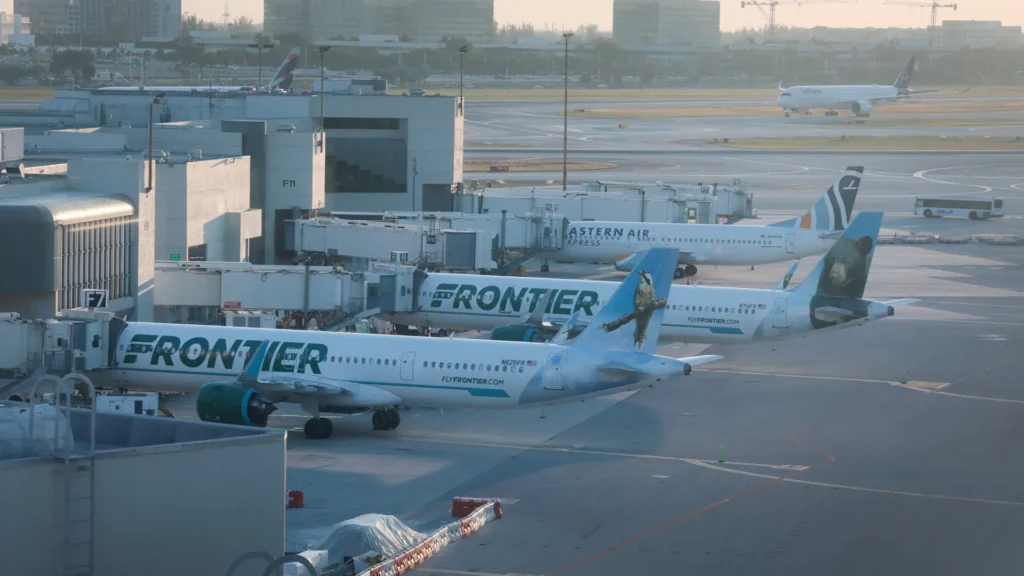
More than 10,000 flights across the United States were cancelled or delayed on Sunday, November 15, as aviation authorities extended their timeline for restoring normal air travel following a nationwide ground stop caused by a technical failure in the air traffic control system.
The disruptions followed a decision by the Federal Aviation Administration (FAA) to halt flights nationwide on Friday, November 13, after a communications failure affected the network responsible for managing air traffic between airports.
The ground stop lasted more than four hours, triggering thousands of cancellations and delays across the country. However, its impact continued throughout the weekend, leaving airlines struggling to restore normal operations.
According to aviation data provider FlightAware, more than 2,300 flights were cancelled while approximately 7,700 others were delayed on Sunday.
The FAA had initially projected that flight operations would return to normal by the end of Sunday. However, authorities later revised the timeline, saying disruptions could continue until Monday.
Speaking during an interview on CBS’s Face the Nation on Sunday, US Transportation Secretary Sean Duffy acknowledged that delays were still being experienced across the country’s airspace but expressed confidence that airlines would resume full operations by Monday.
“Some delays in the airspace right now” remained, Duffy said, adding that the aviation sector was making progress towards restoring full capacity.
He explained that the nationwide ground stop had left aircraft and flight crews out of position, making it difficult for airlines to immediately resume their normal schedules.
“When you have a ground stop like on Friday, we have airplanes and crews that are out of position, so it takes a little bit of time for the airlines to get back and choreographed and at full capacity and operations, but we’re well on our way,” he said.
Duffy previously attributed the technical failure to work being undertaken by telecommunications contractor L3Harris Technologies Inc., which was replacing ageing copper wiring in part of the air traffic control network with modern fibre-optic cables.
According to the secretary, the upgrades resulted in routers becoming overwhelmed by data, causing a network malfunction that disrupted communications.
During his Sunday interview, Duffy revealed that investigators were examining routers from El Dorado, Arkansas, and Amarillo, Texas, to establish whether the incident resulted from installation errors by the contractor or a defective router.
He explained that the telecommunications provider had required the replacement of the old copper infrastructure with fibre technology.
“So we were forced by the telecom provider to actually update that copper to fiber, and we brought in our routers and did the work, and that’s when we saw the flooding of the network,” Duffy said.
The Transportation Secretary noted that the replacement of ageing copper infrastructure had been ongoing for several years as part of efforts to modernise the country’s air traffic control system.
Meanwhile, President Donald Trump has called on Congress to approve additional funding to accelerate the modernisation of the FAA’s air traffic control infrastructure.
In a Truth Social post on November 15, Trump argued that the existing system was outdated and required urgent investment to improve efficiency and prevent similar disruptions.
“If Congress approves the desperately needed money for Air Traffic Control, we can get it built quickly and efficiently,” Trump said.
He added that the government wanted to develop what he described as the best air traffic control system in the world, noting that much of the existing infrastructure was approximately 50 years old.
Duffy is seeking $50 billion from Congress to support the modernisation programme, which includes replacing outdated equipment and improving the technology used to coordinate aircraft movements.
Congress had previously approved $12.5 billion under the One Big Beautiful Bill Act to support improvements to the system, including the replacement of ageing radar equipment and radio communications.
However, the US Department of Transportation said on November 15 that the amount approved so far was insufficient to cover the full cost of the required upgrades.
The department maintained that additional resources would be necessary to fully modernise the country’s air traffic control infrastructure and strengthen the reliability of the aviation network.
Man found dead in house as colleague arrested in Transmara West

If you like our work, you can buy us a soda
Buy us a soda 🥤