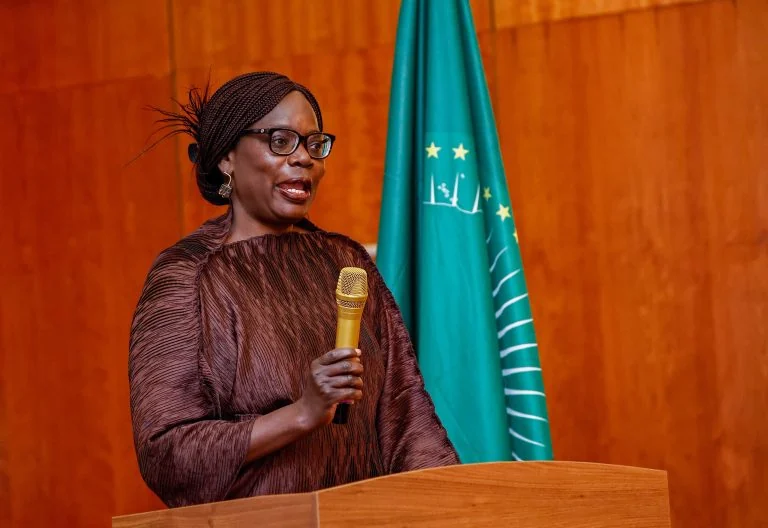
Kenyan law scholar Professor Phoebe Okowa has been re-elected to the International Court of Justice (ICJ), securing a full nine-year term on the United Nations’ principal judicial body.
Okowa secured the seat following several rounds of voting by the United Nations Security Council and General Assembly in New York on Tuesday, November 3, 2026.
She defeated Peru’s Luz del Carmen Ibáñez Carranza in the decisive round, receiving 13 votes against none in the 15-member Security Council. Her victory followed the withdrawal of three other candidates, including Sierra Leone’s Professor Charles Chernor Jalloh, Ecuador’s Marcelo Vázquez-Bermúdez and South Korea’s Jin-Hyun Paik.
The election came after Okowa failed to secure the required eight votes in the Security Council during the initial ballot, despite obtaining sufficient support in the General Assembly.
Under the ICJ election rules, candidates must secure an absolute majority in both the Security Council and General Assembly to be elected.
Okowa’s new term will begin on February 6, 2027, and run until February 5, 2036.
Kenya mounted an extensive diplomatic campaign to secure Okowa’s re-election, with the Ministry of Foreign Affairs undertaking months of engagements with United Nations member states ahead of the November vote.
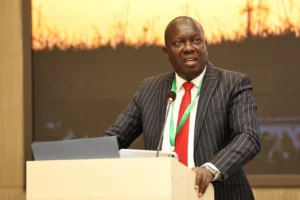
Principal Secretary for Foreign Affairs Korir Sing’Oei led the campaign, with the government highlighting her legal expertise, international experience and contribution to the development of international law.
Following her victory, Sing’Oei welcomed the election and thanked member states for supporting Kenya’s candidate.
“It is with immense pride that I welcome the election of Judge Phoebe Okowa to the International Court of Justice for the 2027-2036 term, and congratulate Judges from the UK, France, Singapore and Jordan on joining the Court. Judge Okowa’s election reflects the confidence of the international community in her capacity to serve the Court at this consequential time,” Sing’Oei said.
He also thanked members of the General Assembly and Security Council for their votes and acknowledged countries that withdrew their candidates during the election process.
“We deeply appreciate members of both the General Assembly and Security Council for their votes. We are equally indebted to Sierra Leone, Korea and Ecuador for withdrawing their candidatures after the third round and helping avoid a protracted electoral process. And to our teams supporting this campaign, thank you all,” he added.
Okowa is a professor of public international law at Queen Mary University of London, where she has built an academic and professional career specialising in international legal matters.
She has extensive experience advising governments and organisations on international legal disputes and has served as counsel in proceedings before international courts and tribunals.
She previously served on the United Nations International Law Commission, becoming the first African woman elected to the body in 2021. The commission plays a key role in the progressive development and codification of international law.
Her initial election to the ICJ in November 2025 made her the first Kenyan to serve on the court and the eighth woman to join its bench.
She was elected to fill the vacancy left by Somali judge Abdulqawi Ahmed Yusuf, who resigned in September 2025. Her initial appointment was limited to the remainder of his term, which was due to expire on February 5, 2027.
Her latest election gives her a full nine-year mandate.
The International Court of Justice is based in The Hague, Netherlands, and serves as the principal judicial organ of the United Nations.
Established in 1945 under the UN Charter, the court settles legal disputes between countries and issues advisory opinions on questions of international law referred to it by authorised United Nations institutions and agencies.
It is distinct from the International Criminal Court, which prosecutes individuals accused of serious international crimes.
The ICJ comprises 15 judges elected independently by the United Nations General Assembly and Security Council. Each judge serves a nine-year term and is eligible for re-election.
Judges sit in their individual capacity and do not represent their home countries.

If you like our work, you can buy us a soda
Buy us a soda 🥤