
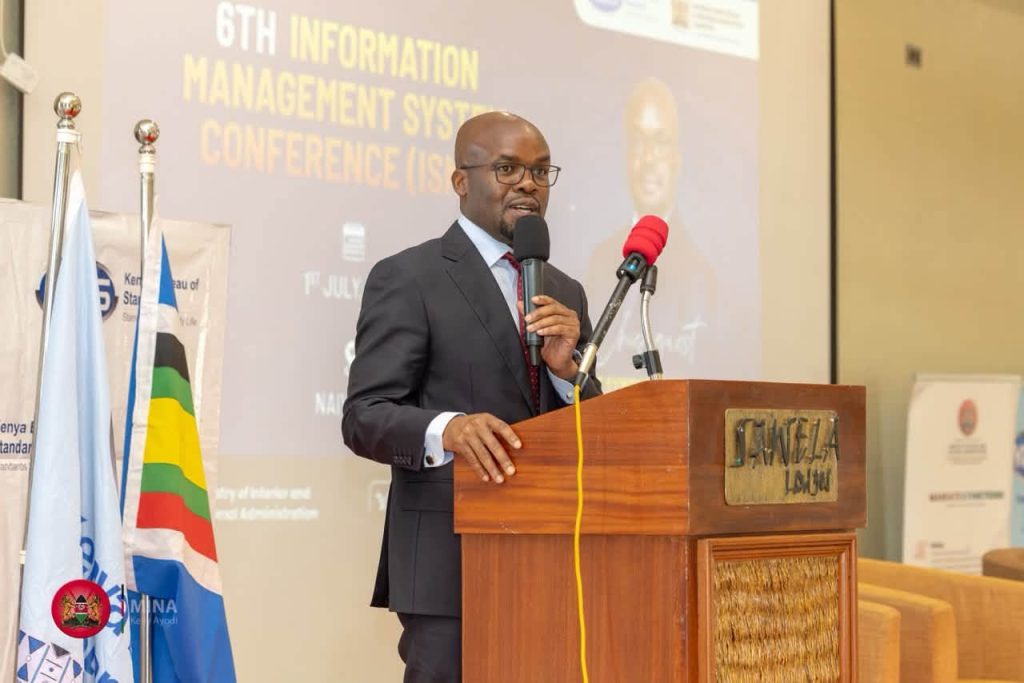
The Government has reaffirmed its commitment to strengthening Kenya’s cybersecurity architecture and developing robust governance frameworks for emerging technologies, including Artificial Intelligence (AI), to safeguard the country’s rapidly expanding digital economy.
Speaking during the opening of the Sixth Annual Information Security Management Systems (ISMS) Conference in Naivasha, Principal Secretary for Internal Security and National Administration, Dr. Raymond Omollo, said digital transformation has become a key driver of economic growth, public service delivery and government transparency, but has also increased exposure to cyber threats that require coordinated national action.
The three-day conference, jointly organized by the National Computer and Cybercrimes Coordination Committee (NC4) and the Kenya Bureau of Standards (KEBS), has brought together cybersecurity experts, government agencies, regulators, academia, private sector players and development partners to discuss emerging cybersecurity challenges and opportunities.
Dr. Omollo said the Government’s digital transformation agenda under the Bottom-Up Economic Transformation Agenda continues to improve service delivery through digital platforms. He cited the success of the eCitizen platform, which now hosts more than 24,000 government services, serves over 15 million users and processes approximately 500,000 transactions daily.
He noted that while digitization has enhanced efficiency, transparency and accountability in government operations, it has also expanded Kenya’s cyber risk landscape.
“National security is no longer confined to traditional security infrastructure. Today, it includes protecting cloud systems, digital payment platforms, telecommunications networks and critical information infrastructure that citizens depend on every day,” he said.
The Principal Secretary highlighted key measures undertaken to strengthen the country’s cybersecurity framework, including implementation of the Computer Misuse and Cybercrimes Act, operationalization of the National Computer and Cybercrimes Coordination Committee and enforcement of the Critical Information Infrastructure Protection and Cybersecurity Management Regulations, 2024.
He said the regulations require organizations managing critical information infrastructure to identify digital assets, secure systems and continuously monitor threats to safeguard essential services.
Dr. Omollo also welcomed Parliament’s approval of the establishment of the National Cybersecurity Agency, saying the institution will enhance national coordination, strengthen resilience and improve Kenya’s preparedness against evolving cyber threats.
On Artificial Intelligence, he warned that rapid technological advancements present both opportunities and risks, particularly through AI-generated deepfakes, misinformation, online fraud, identity manipulation and cyber-enabled attacks.
“As technology evolves, we are witnessing the emergence of AI-generated deepfakes, sophisticated misinformation campaigns and new forms of cybercrime that threaten public trust and national security. Our response must evolve just as rapidly,” he said.
He emphasized that the future of information security extends beyond cybersecurity to addressing the misuse of artificial intelligence and other emerging technologies. He challenged stakeholders to harness AI to strengthen cybersecurity while protecting sensitive information from unauthorized access and misuse.
The Principal Secretary also called for greater investment in local innovation and skills development to position Kenya as a producer of trusted cybersecurity solutions rather than relying solely on imported technologies.
“The next generation of cybersecurity solutions should not only be imported into Kenya; they should also be designed, developed and exported from Kenya,” he said.
He urged participants to use the conference as a platform for practical collaboration, knowledge sharing and the development of actionable recommendations that will accelerate the adoption of internationally recognized information security standards across both the public and private sectors.
Dr. Omollo reaffirmed the Government’s commitment to building a secure, resilient and trusted digital ecosystem that supports innovation while protecting citizens, institutions and critical national infrastructure.
The conference is expected to generate policy, technical and operational recommendations aimed at strengthening Kenya’s cybersecurity framework and enhancing preparedness against emerging digital threats.

If you like our work, you can buy us a soda
Buy us a soda 🥤