
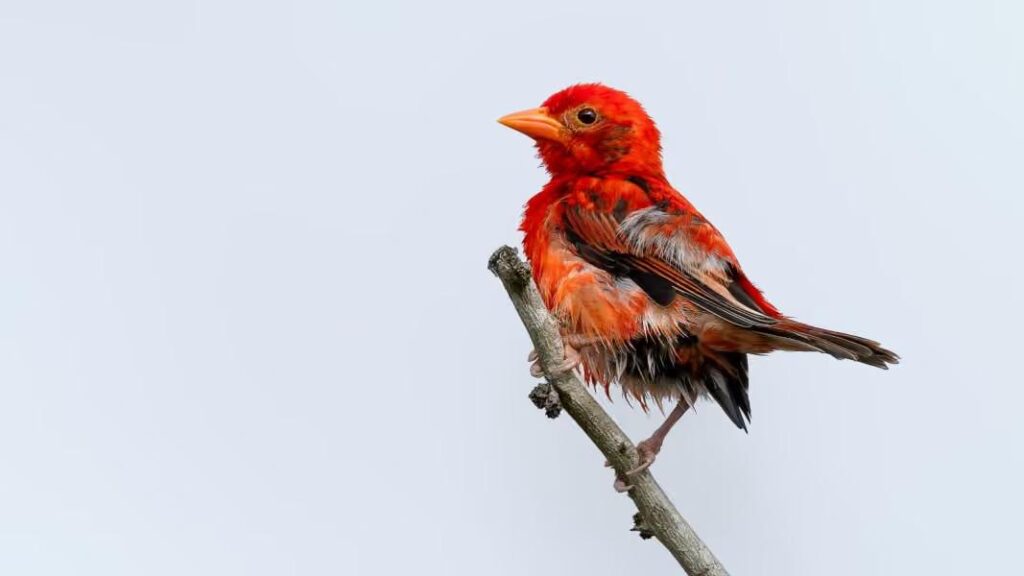
Two Kenyan birders, James Apolloh Omenya and Simon Odhiambo, have gained global acclaim after their recent sighting of the elusive Red Weaver Bird in the Boni-Dodori Forest in Lamu County last month.
The two birders have received global recognition in environmental conservation and ornithology for their recent sighting and documentation of the Red Weaver Bird, which had not been seen or documented since 2014.
Speaking when he confirmed the sighting, Simon Odhiambo, a Murang’a County-based conservationist popularly known as The KenyanBirder, said the rediscovery of the Red Weaver Bird was a thrilling experience after an 11-day field expedition in the wildlife-infested and security-cordoned forest.
“We were excited to make the rediscovery of the Red Weaver Bird in Boni-Dodori Forest. This lost bird species, only found in this forest globally, was last sighted more than a decade ago,” Odhiambo said.
Odhiambo, a Senior Executive at Kakuzi Plc, was accompanied in the field survey and expedition by Omenya, a 29-year-old ornithologist and bird guide, who was also one of five recipients of the 2026 Ornis Birding x Lost Birds Expedition Grants. The award supports birders aged 18-30 years who wish to find a lost species.
In the 2026 Ornis Birding x Lost Birds Expedition Grants award, Omenya chose two birds: the Red Weaver, a target of a prior expedition cut short by security concerns, and the Tana River Cisticola, last documented in 1967. Their core ranges overlap in remote areas of northeastern Kenya near the border with Somalia — landscapes rarely visited by birders and ornithologists.
According to a report published on the Search for Lost Birds web portal, on the morning of July 3, 2026, two voices rose above the shrill call of the Sombre Greenbul in Kenya’s Boni-Dodori Forest. “Our birds!” they shouted as three flashes of red emerged from a bush. The voices belonged to Kenyan birders James Apolloh Omenya and Simon Odhiambo, who had travelled miles by motorbike in search of a species last documented in 2014. After more than a decade, the lost Red Weaver had finally appeared.
According to the Search for Lost Birds web portal, records of the Red Weaver are sparse.
“To our knowledge, the species had been photographed only once before Omenya and his team ventured into the field: in April 2014, when John Musina documented a single male in the Boni-Dodori Forest. The limited number of records is due in part to long-standing uncertainty about the weaver’s identity,” the web portal said.
For more than a century, taxonomists considered the bird a subspecies of the Red-headed Weaver. It was not until 2024 that eBird recognised the Red Weaver as a distinct species, and by 2025 it had cycled onto the Lost Birds list.
To search for this enigmatic bird, Omenya assembled a team that blended scientific expertise, local knowledge, and logistical support. He led the expedition alongside bird photographer Odhiambo, environmentalist Dr Victor Ikawa, Paul Kaberere of the Environmental Compliance Institute, and East Africa tour guides James Mburu and John Gitiri. Motorcycle riders Mohammed Noor and Charles Manhala of Aweer Conservancy, together with driver Caleb, guided and transported the survey team. Their work relied on a wider network of chiefs, county commissioners, village elders, and armed escorts. In the most remote areas, the Kenya Defence Forces (KDF) offered protection against the risk of militant activity.

If you like our work, you can buy us a soda
Buy us a soda 🥤