
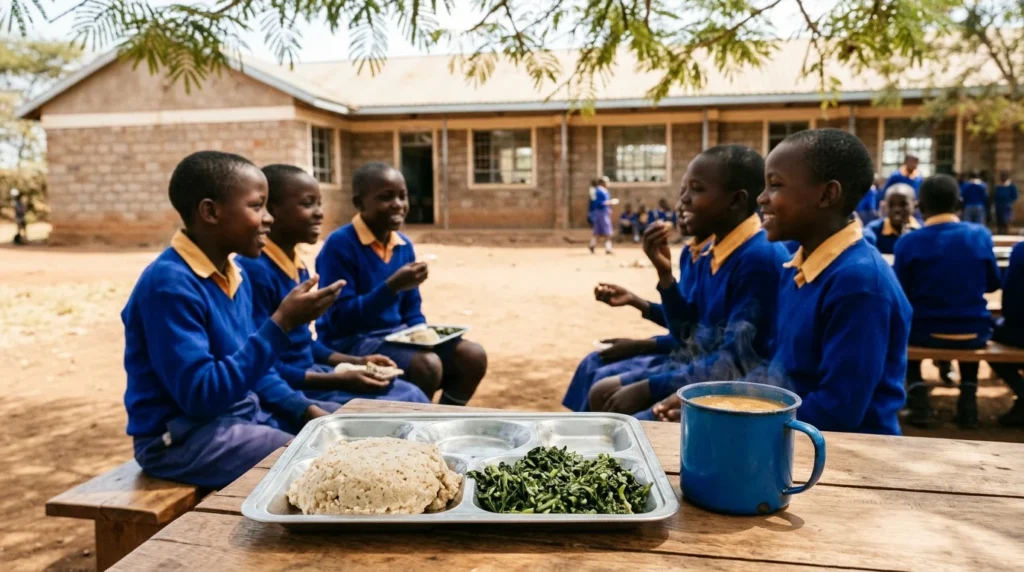
Kenya’s school feeding programmes could provide a growing market for farmers and food processors while improving children’s access to nutritious meals through increased use of fortified whole grains.
The programmes, which serve millions of learners, offer an opportunity to connect agricultural production with public health priorities by incorporating more nutritious maize, rice and wheat into meals served in schools.
The Fortified Whole Grain Alliance (FWGA) says the approach could improve the nutritional value of familiar foods such as ugali and porridge while creating predictable demand for locally produced grains.
Approximately 600,000 learners across multiple counties in Kenya already consume fortified whole-grain maize meal in school meals, either as porridge or ugali, through ongoing programmes and partnerships.
The opportunity is highlighted in an August 2026 report by Boston Consulting Group (BCG), titled Integrating Food and Health Systems in Africa: A High-Return Investment in Health. The report, developed with contributions from The Rockefeller Foundation, Solid’Africa and FWGA, identifies institutional food procurement as a way of linking nutrition improvements with agricultural production and local food processing.
Across Africa, school feeding programmes reach more than 85 million children, providing a substantial and established market for food producers.
According to the report, prioritising nutritious foods in school procurement can generate reliable demand for farmers, millers and processors, strengthening local supply chains while improving the quality of children’s diets.
Whole grains retain the bran and germ, which contain dietary fibre, vitamins and minerals that are largely removed during refining. Depending on the grain and nutrients compared, whole grains provide approximately two to five times the micronutrient density of refined alternatives.
Combining whole grains with appropriate fortification could further improve the nutritional value of staple foods consumed by schoolchildren.
David Kamau, managing director of FWGA and one of the report’s authors, said making nutritious foods more accessible and affordable was essential to addressing malnutrition in low- and middle-income countries.
“Across Low and Middle Income countries (LMICs), millions of children still face the consequences of malnutrition and limited access to nutritious foods. At the Fortified Whole Grain Alliance (FWGA), we are working to make (fortified) whole grains a practical and affordable solution that can improve diets and help children thrive,” he said.
Rwanda has demonstrated how school feeding programmes can support the adoption of fortified whole grains. A 2021 pilot involving 13,500 learners found that 97 per cent preferred fortified whole-grain maize porridge to the refined alternative.
The programme later expanded to more than 74,000 children in 81 schools, with parental approval reaching 99 per cent. The Rwandan government has since started expanding fortified whole-grain maize meal in public schools, with close to 400,000 learners currently consuming Kaunga prepared from the flour.
The country is targeting more than 4.3 million learners through a phased national expansion.
The BCG report estimates that a broader transition to whole-grain maize, unpolished rice and sorghum in Rwanda’s school feeding system could generate annual combined health, fiscal, economic and environmental benefits of between US$120 million and US$155 million.
The report identifies collaboration between governments, schools, farmers, millers, food manufacturers and development partners as critical to translating nutrition objectives into sustainable improvements across food systems.
The findings are being highlighted as Kenya joins organisations from 16 countries in marking International Whole Grain Day on November 19. The global relay, initiated by the Danish Whole Grain Partnership and led by the ICC Whole Grain Initiative, seeks to promote greater consumption of whole grains and their contribution to public health.
FWGA works with governments, development partners, research institutions and private-sector organisations to increase the production and consumption of fortified whole-grain foods, initially focusing on maize, rice and wheat.
Netizens Troll Quiver Lounge Ngong For Humiliating Job Applicants During Interviews

If you like our work, you can buy us a soda
Buy us a soda 🥤