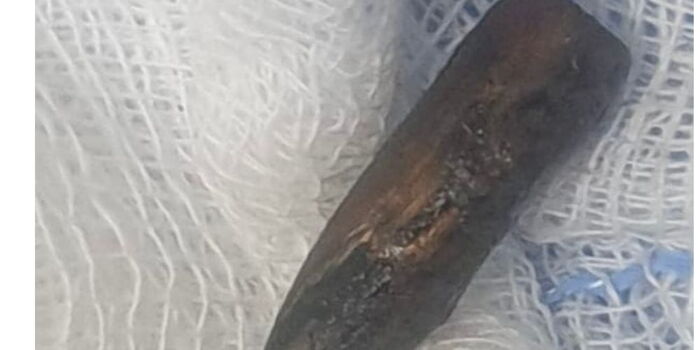
A protester, Samuel Kinyanjui, has finally had a bullet surgically removed from his thigh 14 months after he was shot during demonstrations against the Finance Bill in June 2024.
Kinyanjui’s long wait for treatment was the result of a bureaucratic standoff between the hospital and police, as medical staff refused to operate without official documentation from law enforcement paperwork he was unable to obtain despite repeated efforts.
Speaking to NTV, Kinyanjui recounted how he was caught in a loop between Githurai and Kasarani police stations, each referring him to the other when he tried to secure a P3 form, a document required to receive treatment in cases involving injury from violence.
“The doctor asked me to get a P3 form from Githurai or Kasarani Police Stations, but that failed because Githurai sent me to Kasarani, and when I got there, they redirected me back to Githurai,” he said.
“I’m just heartbroken. I don’t know where to start. My condition doesn’t allow me to move much. I have nothing against anyone I just want to be okay.”
The hospital, adhering to standard procedure in firearm injury cases, insisted that the incident be formally recorded by the police and that an Occurrence Book (OB) number be issued before surgery could proceed.

According to orthopaedic surgeon Dr. Edward Sang, such documentation is necessary for both legal and forensic purposes.
“We require the relevant authorities to confirm awareness of the case and take possession of the bullet once removed either for forensics or for other official uses,” Dr. Sang explained.
The deadlock was only broken after the Independent Policing Oversight Authority (IPOA) stepped in, prompting the long-overdue surgery.
On August 13, activist Hussein Khalid confirmed that the bullet had finally been removed and that Kinyanjui was in recovery.
“Finally, we’ve got the bullet out. After 14 months of pain and suffering with a bullet lodged in his thigh, Samuel Kinyanjui today underwent surgery,” said Khalid.
Kinyanjui’s case has spotlighted the gap between medical care and legal procedure in Kenya, especially for victims of police shootings and protest-related violence.
His story has sparked renewed calls for reforms that would enable emergency treatment without bureaucratic barriers, particularly in cases involving state violence.

If you like our work, you can buy us a soda
Buy us a soda 🥤