

The family of Benedict Kabiru, a Kenyan police officer who went missing while on duty in Haiti under the Multi-National Security Support (MSS) mission, has issued a 30-day ultimatum to the government demanding clarity on his whereabouts or face legal action.
Speaking through their lawyer, Mbuthi Gathenji, the family has formally written to Attorney General Dorcas Oduor requesting an official and unconditional statement on whether Kabiru is alive or dead.
“We have formally written to the AG and requested written, unconditional information about Kabiru,” Gathenji stated, warning of potential court proceedings if the government remains silent.

Kabiru was reported missing on March 25, 2025, during a rescue operation in Port-au-Prince.
His disappearance came just days after the fatal shooting of another Kenyan officer, Samuel Tompoi Kaetuai, in an attack by Haitian gangs.
Now, over a month later, Kabiru’s family says they remain in the dark and are receiving conflicting information from Kenyan and Haitian authorities.
Philip Kamau Kuria, Kabiru’s brother, expressed the family’s frustration:
“The government of Kenya said he was missing in action, but the press release from Haiti tells a different story. As a family, we’re confused we don’t know if our kin is alive or dead.”
Kabiru’s uncle, Daniel Kabiru, also criticized the lack of transparency from the government:
“The government, which is Kabiru’s employer, should remove our distress and anxiety by telling us the truth.
They should update us on the progress of the investigations and tell us whether he is there or not, instead of leaving us in the dark.”
The family has made it clear they are prepared to seek court orders compelling the state to disclose Kabiru’s status if their demand for information goes unmet.
“We want direct confirmation from Haiti itself. This daily narrative about an ongoing search is exhausting,” their lawyer said.
Meanwhile, on April 5, MSS Spokesperson Jack Ombaka addressed a viral video purporting to show Kabiru dead, saying the footage had been manipulated using artificial intelligence (AI) by gangs in Haiti.
“That video is not authentic,” Ombaka stated. “Many of the Haitian gangs thrive on propaganda, and it’s very unlikely that the video in circulation is real.”
He added that the MSS mission had taken steps to notify Kabiru’s family and next of kin, and that his office also functioning as the Directorate of Strategic Communication was committed to ensuring accurate and timely updates.
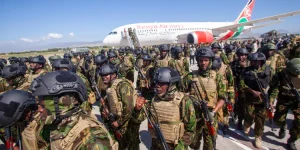
Kabiru, who was due to return to Kenya in four months, is among hundreds of Kenyan officers deployed to Haiti as part of the MSS initiative aimed at restoring order in gang-controlled areas, including the Haitian capital.
The case has drawn attention to the risks facing Kenyan security forces abroad and raised questions about communication protocols and government accountability in times of crisis.