
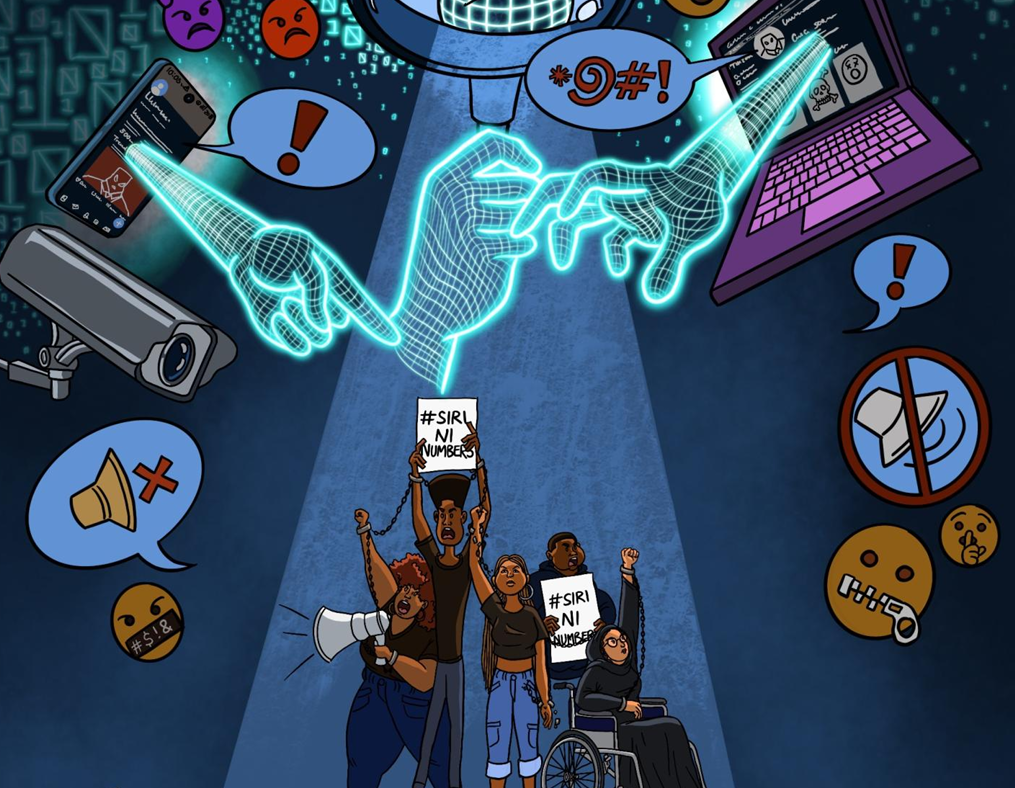
Amnesty International’s latest report highlights the growing use of technology-enabled violence against young human rights defenders (HRDs) in Kenya, carried out by state authorities under President William Ruto’s government during the 2024 and 2025 “Gen Z” protests.
At a moment when youth mobilization online was reaching unprecedented levels, Kenyan authorities responded with intimidation, threats, and state violence that extended from digital harassment into severe human rights abuses in the physical world, including enforced disappearances and extrajudicial killings.
Amnesty International has documented hundreds of violations in connection with the June 2024 protests and subsequent crackdowns, including arrests, disappearances, and killings.
This report focuses specifically on the state’s suppression of online protest activity and the use of technology as part of broader repressive tactics.
It is the second installment in a global research project on tech-facilitated violence against child and young HRDs, following the 2024 report “I turned my fear into courage”: Red-tagging and state violence against young human rights defenders in the Philippines.
It also contributes to Amnesty’s ongoing work on digital and gender-based violence and holding Big Tech accountable for failing to respect human rights.
The research draws on desk analysis, social media monitoring, and interviews with 31 young HRDs aged 18–28, alongside input from seven older HRDs involved in the 2024 protests, who provided insights on protest mobilization and human rights activism over the past decade.
Participants represented diverse causes, including student movements, social justice networks in informal settlements, feminist and LGBTI activism, climate justice, and children’s rights advocacy.
Many came from marginalized backgrounds and framed their participation in the protests as part of a broader struggle for social justice in post-colonial Kenya.
Field research was conducted between December 2024 and October 2025, including in-person focus groups in Nairobi, Mombasa, and Kisumu in March 2025, and online interviews through September 2025.
All participants provided informed consent and were given options to pause, stop, or speak off the record, with access to mental health support. Amnesty cross-checked information from participants with desk research, relevant human rights law, and media reports.
Social media analysis mapped accounts involved in coordinated disinformation and harassment campaigns, particularly on X (formerly Twitter).
The study also incorporated participatory inputs from community consultations and a youth HRD workshop in Nairobi in April 2025.
Background: The Gen Z Protests
The June–July 2024 youth-led demonstrations, widely known as the “Gen Z Protests,” were among the largest in recent Kenyan history, sparked by widespread opposition to a proposed Finance Bill seen as deepening economic hardship for young people.
The protests began in Nairobi and spread to 44 of Kenya’s 47 counties, evolving into a broader call for systemic reforms under the slogan “Ruto must go.”
Although largely peaceful, the state responded with unlawful and excessive force, violating rights to freedom of expression, assembly, and security, as well as the right to life and freedom from torture.
The peak of these protests occurred on 25 June 2024, when demonstrators entered parliament to oppose the legislation.
Police used live and rubber bullets, water cannons, tear gas, and batons. Amnesty International’s investigation found multiple violations of international human rights law, including standards on the use of force and firearms by law enforcement.
In the aftermath, arbitrary arrests, enforced disappearances, and brutal crackdowns became routine.
By late August 2024, the Law Society of Kenya reported 72 individuals abducted, released, or still missing in relation to the protests, with 13 disappearing on 25 June alone. Security forces responsible were largely drawn from the Directorate of Criminal Investigations, Rapid Deployment Unit, military intelligence, Anti-Terrorism Police Unit, and National Intelligence Service. Some recovered bodies bore signs of torture.
By December 2024, a renewed wave of disappearances targeted vocal online activists, marking a year of escalating state violence. Amnesty estimates 63 deaths, 83 abductions, and 2,000 arbitrary arrests in connection with the protests.
Continued Protests in 2025
A year later, in June 2025, young HRDs mobilized again to protest poor governance, police brutality, and the lack of accountability for the 2024 killings.
The in-custody death of Albert Ojwang, a 31-year-old digital creator arrested over online activity, intensified public anger.
Clashes with police involved tear gas, rubber bullets, and live ammunition, while masked attackers were reportedly deployed to target protesters, sometimes with police support.
Over 400 people were injured and at least 16 killed, including bystander Boniface Mwangi Kariuki.
On 7 July 2025, nationwide protests marked Saba Saba Day, commemorating historic pro-democracy demonstrations.
Police cordoned off Nairobi’s Central Business District, redirecting protesters to satellite towns. At least 38 people were killed, with over 500 injured.
Authorities charged protesters with terrorism, murder, robbery, malicious damage, theft, and unlawful assembly, disproportionately affecting 20–29-year-olds.
Between 2024 and 2025, Amnesty estimates over 3,000 arbitrary arrests, 83 enforced disappearances, and 128 killings.
Although government officials issued statements emphasizing police accountability and announced new directives on the use of force, Amnesty International has identified systemic failures in holding officers accountable for unlawful conduct.
IED explosion kills 2 policemen on Liboi-Kulan road in Garissa