
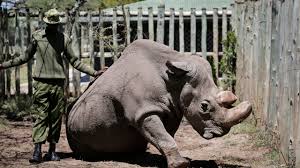
In a last-ditch effort to save the critically endangered Northern White Rhino (NWR) from extinction, the Kenya Wildlife Service (KWS), in collaboration with global scientific partners under the BioRescue consortium, is entering a pivotal phase in a cutting-edge reproductive science project that aims to bring the species back to life.
With only two Northern White Rhinos remaining on the planet both female and living in Kenya the stakes are higher than ever.
A KWS official, speaking on Friday, said the mission is at a critical point after six years of sustained effort.
“This mission is very important. For a fact, we lost the last two remaining Northern White Rhinos capable of natural reproduction. We’re staring at the extinction of the species,” the official said.
Launched in 2019, the BioRescue project brings together world-leading scientists and veterinarians from countries including Germany and Italy, working hand-in-hand with Kenyan conservationists to revive the NWR through advanced assisted reproduction technologies.
Embryo Creation and Transfer Process
The process begins with the harvesting of oocytes (egg cells) from the two remaining Northern White Rhinos housed at Ol Pejeta Conservancy in Laikipia, Kenya.
The eggs are then transported within 24 hours to a specialized lab in Cremona, Italy, where they are matured and fertilized using preserved sperm from deceased Northern White Rhino bulls.
The fertilized embryos are stored and later transported back to Kenya to be implanted into surrogate Southern White Rhino females, who carry the pregnancies.
“We’ve already confirmed that the system works. About two years ago, a Southern White Rhino embryo was successfully implanted into a surrogate, resulting in pregnancy. That gave us the green light to attempt the same using Northern White Rhino embryos,” the official added.
Progress and Milestones
So far, the team has carried out 21 oocyte collection cycles, conducted quarterly over the last six years.
From these, scientists have managed to develop 37 viable Northern White Rhino embryos a significant scientific achievement considering the odds.
“Every step we take from egg collection to fertilization and embryo storage brings us closer to possibly seeing a Northern White Rhino calf born again,” the official noted.
International Collaboration
The BioRescue consortium includes experts from Germany’s Leibniz Institute for Zoo and Wildlife Research, Italy’s Avantea Lab, and other organizations, with Kenya playing a central role by housing the remaining rhinos and offering conservation leadership.
KWS officials hailed the collaboration as a milestone for Kenya and global conservation, emphasizing that the country remains a key player in saving not just a species, but a vital part of Earth’s natural heritage.
“This is not just about science; it’s about hope hope for the Northern White Rhino, and for future generations to see these magnificent animals once again roam our plains.”
With the groundwork now laid and the first Northern White Rhino embryo transfer on the horizon, conservationists are hopeful that history will be made and extinction averted.
Teachers To Get Salary Boost As TSC Signs Sh33 Billion Pay Deal With Unions