
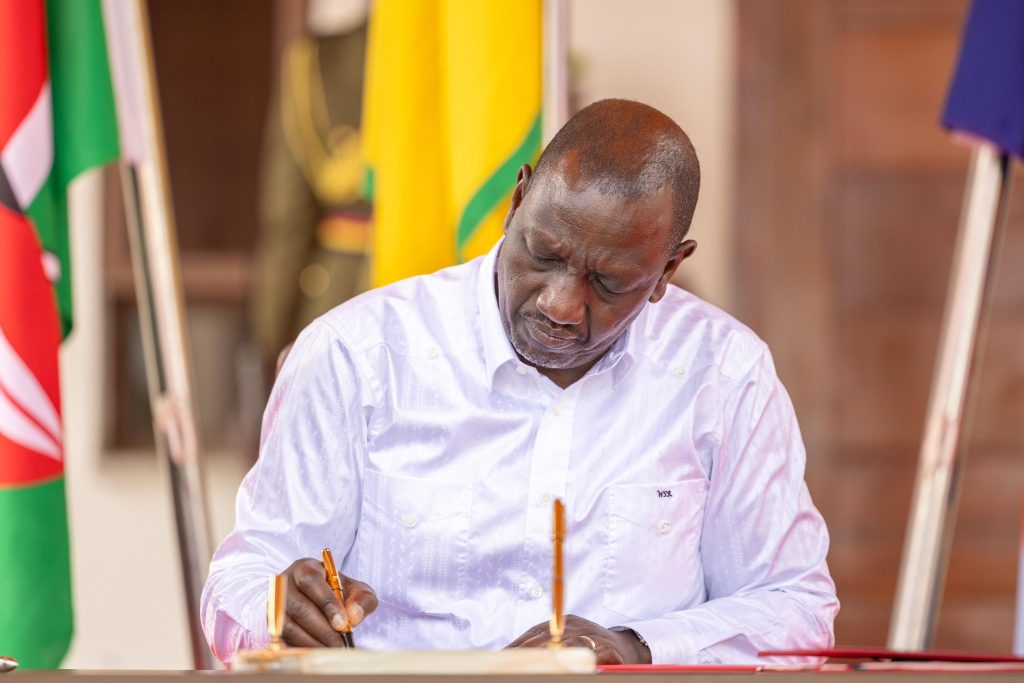
President William Ruto has signed into law the County Allocation of Revenue Bill, 2025, and the County Public Finance Laws (Amendment) Bill, 2023, marking a major step toward strengthening financial autonomy and accountability in county governments.
The County Public Finance Laws (Amendment) Bill, sponsored by Meru Senator Kathuri Murungi, amends the Public Finance Management Act to establish a dedicated County Assembly Fund in each of the 47 counties.
The fund is intended to cover administrative expenses and facilitate asset acquisitions, including land and buildings.
Although the existing County Assembly Services Act already provides for a fund, the new law introduces more comprehensive regulations concerning its management, revenue sources, and procedures for requesting funds.
Under the new law:
- The Clerk of the County Assembly will serve as the fund administrator.
- Funds will be held at the Central Bank of Kenya and ring-fenced for approved assembly functions.
- Any unutilized funds at the end of the financial year will be rolled over.
- Funds will primarily come from county assemblies’ own appropriations from the County Revenue Fund.
- County treasuries must release the funds by the 15th of each month, subject to prior assembly approval.
Supporters of the amendments say the changes will empower county assemblies to better perform their oversight and legislative roles without over-reliance on the executive arm of county governments.
Meanwhile, the County Allocation of Revenue Bill, 2025, sponsored by Senate Budget and Finance Committee Chair Ali Roba, sets the equitable revenue share for counties in the 2025/26 financial year at sh415 billion a 7.1% increase from the previous allocation of sh387.4 billion.
Key highlights of the new revenue law include:
- Implementation of the fourth revenue-sharing formula under Article 217 of the Constitution, approved earlier this year by Parliament.
- Mandatory monthly publication of actual disbursements by the National Treasury.
- County treasuries must record and report receipts in their quarterly and annual financial statements, enhancing transparency.
- Budget ceilings for county executives and assemblies are now clearly defined.
- Clear funding rules for functions transferred from counties to the national government.
- Quarterly performance reporting to the Senate and respective county assemblies is now mandatory.
President Ruto signed both bills into law at the Homa Bay State Lodge, reiterating his administration’s commitment to strengthening devolution and enhancing service delivery at the grassroots level.
Mary Fowler Net Worth: Australia Women’s Football Rising Star