
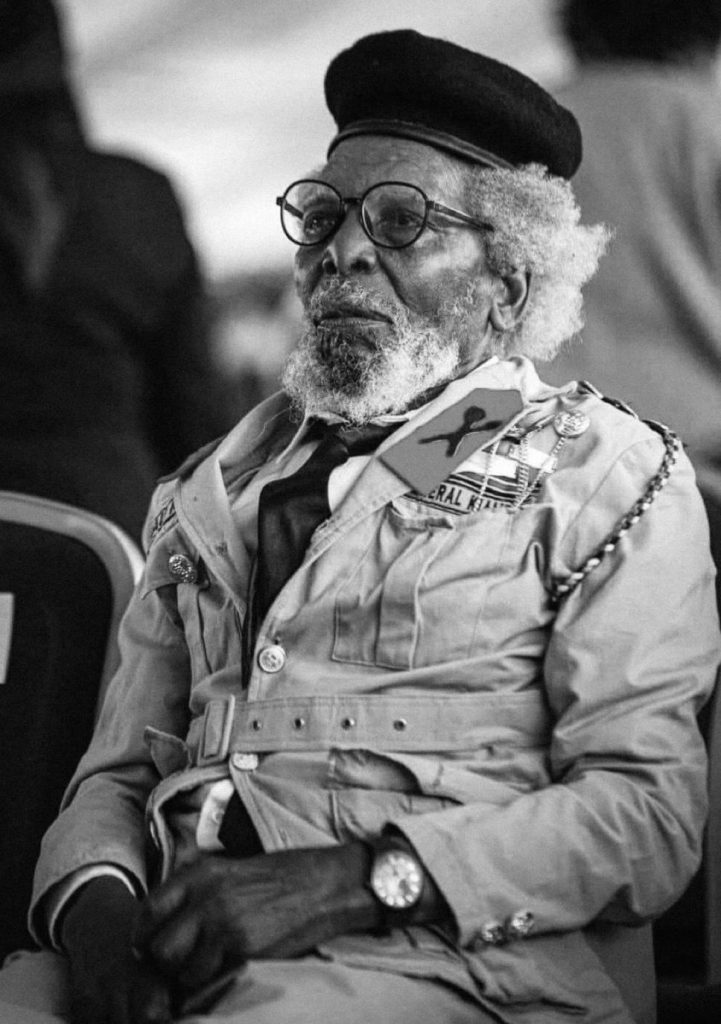
Kiambati wa Njora, the last surviving of the 12 Mau Mau generals who led Kenya’s armed resistance against British colonial rule, has died, marking the end of an era in the country’s liberation history.
The revered freedom fighter passed away on Tuesday morning at his home in Ngorika village, Ol Kalou, Nyandarua County, his family confirmed.
He was among the highest-ranking commanders of the Mau Mau uprising that fought to end colonial domination and reclaim African land.
Former Deputy President Rigathi Gachagua said he had received news of General Kiambati’s death with deep pain, noting that the passing rekindles painful but proud memories of Kenya’s long and bloody struggle for independence.
“His death reminds us of the sacrifices made by a generation that endured immense suffering so that Kenya could be free,” Gachagua said.
General Kiambati hailed from Nyandarua County, a region that became a stronghold of the Mau Mau rebellion and produced some of the fiercest fighters during the violent anti-colonial war of the 1950s.
The area bore the brunt of British counter-insurgency operations, mass arrests, forced detentions, and collective punishment.
He now joins a revered roll call of freedom fighters who shaped Kenya’s liberation, including Field Marshal Dedan Kimathi, Mukami Kimathi, General China (Waruhiu Itote), General Mwariama, General Stanley Mathenge, General Mbaria, General Kubu Kubu, General Tanganyika, and General Baimungi.
The Mau Mau fighters waged war with rudimentary weapons against a colonial administration armed with bombs, bullets, and modern military equipment.
Thousands of Africans were killed, detained, or displaced during the conflict, which historians widely regard as a turning point in Kenya’s journey to independence.
As tributes pour in, Kenyans are also reflecting on the darker chapters of the war, including the Lari Massacre and the role played by homeguards and collaborators who aided British counter-insurgency efforts, betraying fellow Africans for material rewards and colonial favour.
Despite the heavy human cost, the struggle ultimately forced political reforms that culminated in Kenya’s independence in 1963.
With the death of General Kiambati wa Njora, Kenya loses a living link to the Mau Mau resistance—a generation whose sacrifices laid the foundation for the nation’s freedom and sovereignty.
Steering the gateway of trade: Inside Kenya Ports Authority’s legacy, reform drive