
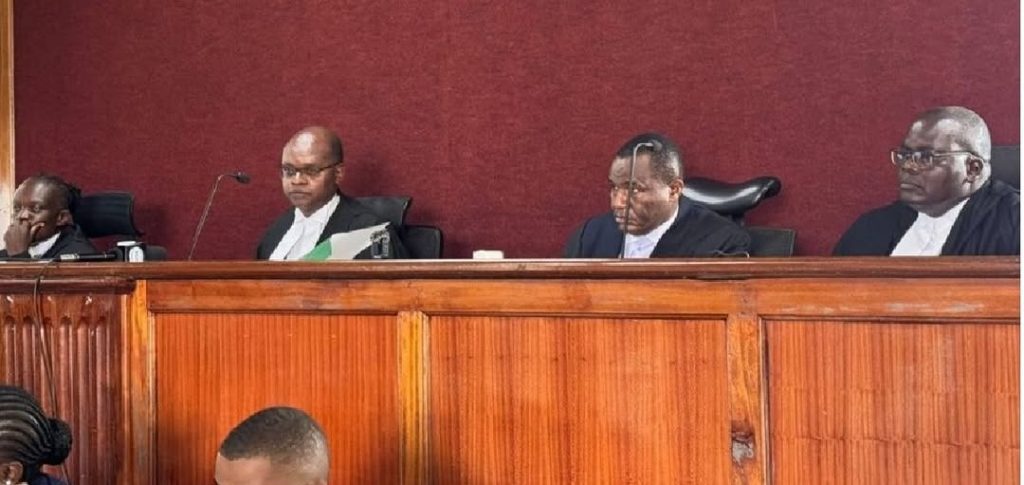
The High Court has declared unconstitutional an advisory issued by former Chief Justice David Maraga recommending the dissolution of Parliament over its failure to implement the two-thirds gender rule.
In a landmark ruling, the court found that the advisory was issued prematurely and without following the constitutional procedures outlined under Article 261(6)(b) of the Constitution.
According to the judges, the Chief Justice was required to ensure that court orders directing Parliament to enact the necessary legislation were formally transmitted to both Parliament and the Attorney General before advising the President on the dissolution of the House.
“The advisory was issued before the constitutional process had been fully complied with,” the bench held, noting that the failure to complete the required procedural steps rendered the process defective.
As a result, the court declared the advisory null and void from the outset.
The judges further emphasized that Parliament is a constitutional institution whose obligations extend beyond the tenure of individual members and electoral cycles.
While acknowledging that certain parliamentary business such as bills may lapse, the court stated that judicial orders remain binding and do not expire simply because a parliamentary term has ended.
“Court orders remain enforceable and binding regardless of changes in the composition of Parliament,” the court observed, stressing the need for strict compliance with judicial directives.
The advisory in question stemmed from Parliament’s failure to enact legislation implementing the two-thirds gender principle as required by the Constitution.
The matter traces back to a High Court order issued in March 2017, which directed Parliament to pass the required law within 60 days. However, repeated attempts to pass the legislation in both the National Assembly and the Senate failed.
The continued non-compliance prompted several petitions seeking to compel the Chief Justice to advise the President to dissolve Parliament under Article 261(7) of the Constitution.
Acting on the petitions, Maraga advised former President Uhuru Kenyatta to dissolve Parliament, arguing that the Constitution left him with no discretion once Parliament had failed to comply with the court order.
At the time, Maraga maintained that his role was purely constitutional.
“The Constitution does not grant the Chief Justice discretion once the threshold for non-compliance has been met,” he argued while issuing the advisory.
The advisory was later challenged by the State, with the Attorney General seeking the court’s interpretation on its legality and the appropriate constitutional path forward.
The dispute sparked debate across government, with concerns that the move could deepen tensions between the Executive and the Judiciary, which were already strained over the implementation of court decisions.
Several parliamentary leaders also opposed the advisory.
Former National Assembly Speaker Justin Muturi argued that there was no explicit constitutional requirement compelling Parliament to enact specific legislation governing the two-thirds gender rule for elected positions.
Former Majority Leader Amos Kimunya and former Minority Leader John Mbadi also questioned the practicality and timing of the advisory, particularly during the COVID-19 pandemic.
The High Court’s ruling now settles a constitutional dispute that has lingered for years, clarifying the procedural requirements that must be met before a Chief Justice can advise the President to dissolve Parliament for failure to enact constitutionally mandated legislation.
Gachagua Faults Ruto Administration for ‘Luxury Spending’ in New Budget

If you like our work, you can buy us a soda
Buy us a soda 🥤