
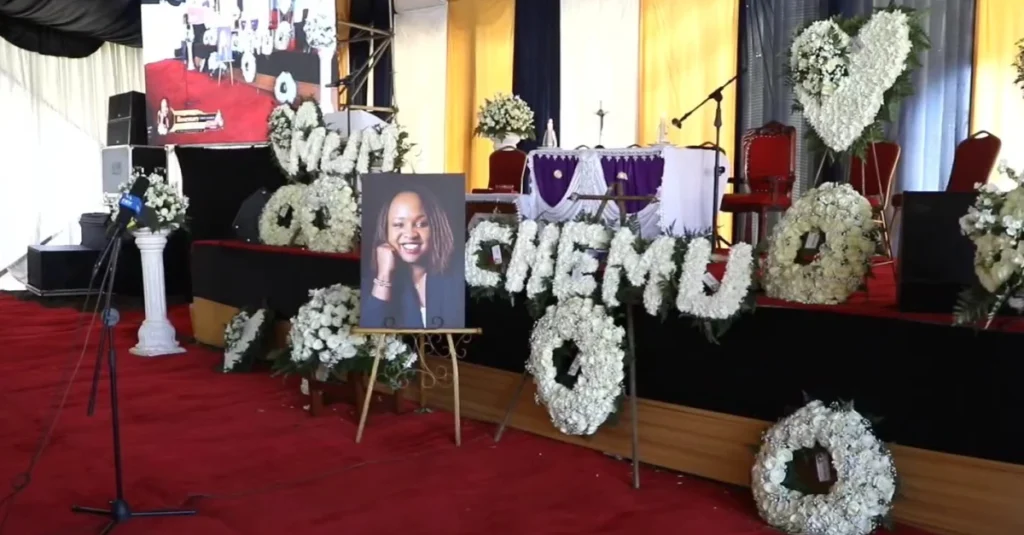
The drama surrounding the death and custody of the body of Rosemary Chemutai Koech (also referred to as Rosemary Chemutai Kimwatu), a KCB senior manager, deepened with her parents conducting the burial on Friday night.
This was hours after a court stopped the burial.
Rosemary, who served as head of data protection in KCB’s risk division, died by suicide on August 21 at the age of 40 at a house she lived in with her children in Ngong, Kajiado County, following a strained relationship with her husband, Kevin Migwe Kimwatu.
A Nairobi court had earlier on Friday temporarily stopped the burial and ordered Lee Funeral Home not to release the body pending the hearing and determination of a case filed by her husband.
The body had however been moved on August 25.
Senior Principal Magistrate Agnes Mwangi of the Milimani Court in Nairobi issued interim orders on Friday restraining the family, Lee Funeral Home and KCB from moving the body of the deceased. She also barred the family from conducting the burial without the consent of the deceased’s husband.
However, the burial was conducted at around 7.30pm at Chepseon village in Kipkelion East Constituency, Kericho County.
Clan chairman Samwel Keter, who is also a relative, explained on Saturday why.
“What’s being circulated on social media is not true; they are just pushing an agenda.
Our daughter died the way she did (by suicide, and in our culture, that means you are not supposed to stay unburied tor more than three or four days.
“Also, when a post-mortem is conducted, a funeral has to happen within two days. We did whatever we did because of our culture so that something like that (suicide) will not happen again. Maybe that’s why people are saying whatever they are saying. We did that according to the Kalenjin culture, not just Kipkendek (the name of the clan) culture,” Keter said.
“Bodies used to be buried at night among members of the Kipsigis community; that is why, in the current generation, the final ceremony is done late in the evening. It is an old-age tradition,” he said.
He said that in the event a parent insists on burying their daughter, who had been married off because of existing and unresolved differences with the spouse, they should return the dowry that was paid to them as a result of the marriage.
He said police investigations and postmortems had complicated the traditional practice of conducting funerals promptly.
“There is nothing wrong with holding a service atter one has been buried, as it is within the mourning window for the immediate family, he said.
It has also emerged that the body was moved from Nairobi to Kericho on August 25 as a tussle ensued between Koech’s parents and her husband, Kevin Kimwatu, with whom she had a sour relationship.
Heavy police presence at the entrance to
the homestead drew the attention of neighbours and passers-by as it emerged
that close family members were
conducting the burial rites.
On Saturday, relatives and friends converged at the homestead to offer their condolences in one of the most controversial deaths and burials in the
country in recent times.
KCB revealed the next kin of the late Koech amid push and pull on who should bury her.
Her estranged husband Kevin Migwe Kimwatu, moved to court and obtained orders stopping the planned burial pending the hearing of the dispute.
The revelations were contained in a letter dated August 25 from the bank to the Lee Funeral Home prompting the release of the body for burial on Friday.
The bank released a letter stating Judy Koech-Oyamo, the sister of the late Rosemary Chemutai Koech, and her son, Charles Migwe Kimwatu as her next of kin in employment records held by KCB Bank Kenya Limited.
The bank confirmed that the two are the persons listed in its records as the next of kin of Koech, who died on August 21, 2026 in Ngong, Kajiado County.
In a letter issued by KCB’s Head of Shared Services, Risk, Compliance and Governance, Robley Ngoje, the bank said Koech was an employee of KCB Bank Kenya Limited and served as Head of Data Protection within the Risk Division until her death.
The bank said Koech-Oyamo and Kimwatu may liaise with the funeral home concerning the release, collection and burial arrangements for the deceased.
The confirmation was issued specifically to facilitate funeral and mortuary arrangements.
However, KCB cautioned that being recorded as next of kin did not automatically make the two legal representatives of Koech’s estate or confer entitlement to her property and benefits.
The bank said the letter should not be interpreted as confirmation of legal representation of the estate or entitlement to terminal dues, insurance benefits, pension benefits or any other assets belonging to the deceased.
“Such matters shall be dealt with upon presentation of the appropriate legal documentation, including letters of administration, grant of probate or other documents required by law,” the bank said.
The clarification is significant because next-of-kin details contained in employment records primarily serve administrative and contact purposes and do not, on their own, determine who has the legal authority to administer or inherit a deceased person’s estate.
KCB asked the funeral home to extend the necessary assistance to the family as they make arrangements following Koech’s death.
Koech held a senior role in KCB’s Risk Division, serving as the bank’s Head of Data Protection until her death.
Her position placed her within a critical function responsible for data protection matters at the financial institution.
The bank’s confirmation was limited to her employment status and next-of-kin information and did not address the administration or distribution of her estate.
An autopsy on the body of Koech confirmed that the a 40-year-old executive who was found dead at a house in Ngong, Kajiado County, died by suicide. The examination was conducted at Lee Funeral Home by Chief Government Pathologist Dr Johansen Oduor and was attended by detectives and the family. Koech had been experiencing marital difficulties before her death, with her family alleging that she had been involved in prolonged domestic and financial disagreements with her husband.
The family also confirmed the bank supported her throughout her challenges.
“We as the parents of Rosemary Koech have no doubts in our minds that KCB accorded Rosemary all the necessary space and support to thrive and be the best she could in her career ladder. In sickness and at her demise, KCB stood with the family and came through where help was required. We are forever grateful. Whatever narratives are going on does not represent the family stand and we wish to be allowed to mourn our dear child in peace,” the family said in a statement. The couple had been married for more than 20 years and had four children. The family had initially lived together in a house at Memusi in Matasia, located within the ancestral compound of the husband’s parents.

If you like our work, you can buy us a soda
Buy us a soda 🥤