
ICT and Digital Economy Cabinet Secretary William Kabogo has challenged President William Ruto’s recent criticism of former President Uhuru Kenyatta’s development record, arguing that the two leaders cannot be separated from the successes and failures of the Jubilee administration they jointly led.
William Kabogo made the remarks during a Kameme FM interview on Monday, August 17, 2026, as political debate intensified over Ruto’s assessment of Uhuru’s decade in office.
The Cabinet secretary, who served as Kiambu governor during part of the Jubilee era, maintained that Ruto was not merely an outsider to the previous administration but its deputy president for the entire 10 years.
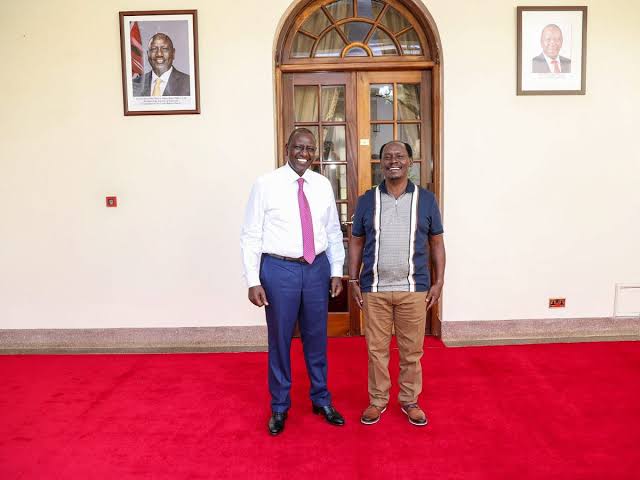
Kabogo: Ruto Cannot Distance Himself From Jubilee Record
William Kabogo ’s argument was anchored on the shared political responsibility between Uhuru and Ruto, who ran on the Jubilee ticket in the 2013 and 2017 elections.
According to the former Kiambu governor, it would be unfair for Ruto to highlight shortcomings associated with the Uhuru administration while simultaneously taking credit for projects and achievements delivered during the same period.
“Sometimes politics is a very dirty game. The current president was Uhuru’s deputy. If they succeeded, they succeeded together, and if they failed, they failed together. They were joined at the hip by a common ticket,” Kabogo said.
His remarks effectively placed the Jubilee administration’s record in a broader context, suggesting that accountability should extend to both men because they occupied the country’s two highest executive positions throughout the period.
Kabogo’s intervention also reflects the changing political relationship between Ruto and Uhuru.
The two were once among Kenya’s most closely associated political partners, campaigning together under the “UhuRuto” banner before their relationship deteriorated after the 2017 election and eventually collapsed ahead of the 2022 polls.
Ruto Renews Attack on Uhuru’s Legacy
Kabogo’s comments came days after Ruto renewed his criticism of Uhuru while addressing a rally in Eldoret on Thursday, August 13.
During the rally, Ruto questioned the delivery of some programmes associated with the previous administration, including affordable housing, universal healthcare and education.
He also accused Uhuru of allegedly supporting political figures seeking to challenge his administration ahead of the 2027 General Election.
“When you look at those people, didn’t their sponsor fail at matters of affordable housing? Now he has gone to organise his proxies, sending people here to come and compete with me,” Ruto said.
The President has also sought to present his administration’s development record as stronger than that of his predecessor while portraying the opposition as lacking a convincing policy alternative.
That renewed criticism has reopened a familiar political argument: how much responsibility should Ruto bear for the Jubilee government’s record, given that he served as Uhuru’s deputy from 2013 until 2022?
Jubilee’s Development Record Remains Contested
The debate is complicated by the fact that the Jubilee administration oversaw several major infrastructure projects while also facing criticism over stalled programmes, rising public debt and projects that encountered implementation problems.
Among the major projects associated with the period were the Nairobi-Mombasa Standard Gauge Railway, the Nairobi Expressway, Dongo Kundu bypass, Kisumu Port refurbishment and numerous road projects.
The Jubilee government also pursued major programmes in housing, healthcare, education, agriculture and energy.
The SGR, for instance, became one of the most visible symbols of the Uhuru-Ruto administration’s infrastructure agenda.
The 472-kilometre Nairobi-Mombasa railway was launched in 2017 and became one of the largest infrastructure investments undertaken during the Jubilee years.
The administration also claimed significant expansion of the road network.
Uhuru’s government said it had constructed thousands of kilometres of tarmac roads, while other projects such as Dongo Kundu and the Nairobi Expressway were intended to improve connectivity and reduce transport bottlenecks.
However, the Jubilee years were not without controversy. Some projects stalled or encountered financial, procurement and implementation challenges, including the Arror and Kimwarer dams and several stadium projects.
This mixed record has allowed both supporters and critics of the former administration to present different interpretations of its legacy.
Ruto Once Claimed Role in Jubilee Projects
Interestingly, Ruto himself previously highlighted his contribution to projects implemented during the Jubilee administration.
In March 2022, while still serving as deputy president, Ruto said he had played a significant role in delivering infrastructure projects under Uhuru’s government.
He specifically claimed that some key decisions were made from his official residence in Karen.
“In the first term I am the person who sat down with then Transport CS Michael Kamau and Petroleum CAS Eng. John Mosonik and it is on my table in Karen that we changed the building code and that is how we have delivered the 10,000 kilometres of road,” Ruto said at the time.
The earlier remarks provide additional context to Kabogo’s current argument that Ruto was an active participant in the Jubilee government rather than a detached observer.

Political Battle Ahead of 2027
The exchange between Kabogo and Ruto comes as Kenya’s political class increasingly turns its attention to the 2027 General Election.
Ruto has accused Uhuru of supporting politicians opposed to his administration, while political actors allied to the former president have increasingly questioned the current government’s performance.
Kabogo’s intervention is therefore significant because he is serving in Ruto’s administration while publicly defending the record of the former president with whom he has had a long political association.
His remarks could fuel further discussion within the Kenya Kwanza administration over how the current government should address the legacy of the Jubilee years, particularly when some of the same leaders who were responsible for implementing those programmes remain active in national politics.
At the heart of the dispute is a question that is likely to remain prominent as the 2027 elections approach: whether the achievements and failures of the Uhuru administration should be attributed solely to the former president, or jointly to the leadership team that governed Kenya for a decade.
Kabogo’s position is clear, Ruto and Uhuru were political partners, and history should judge their Jubilee record together.
FOLLOW NAIROBI NEWS ON FACEBOOK

If you like our work, you can buy us a soda
Buy us a soda 🥤