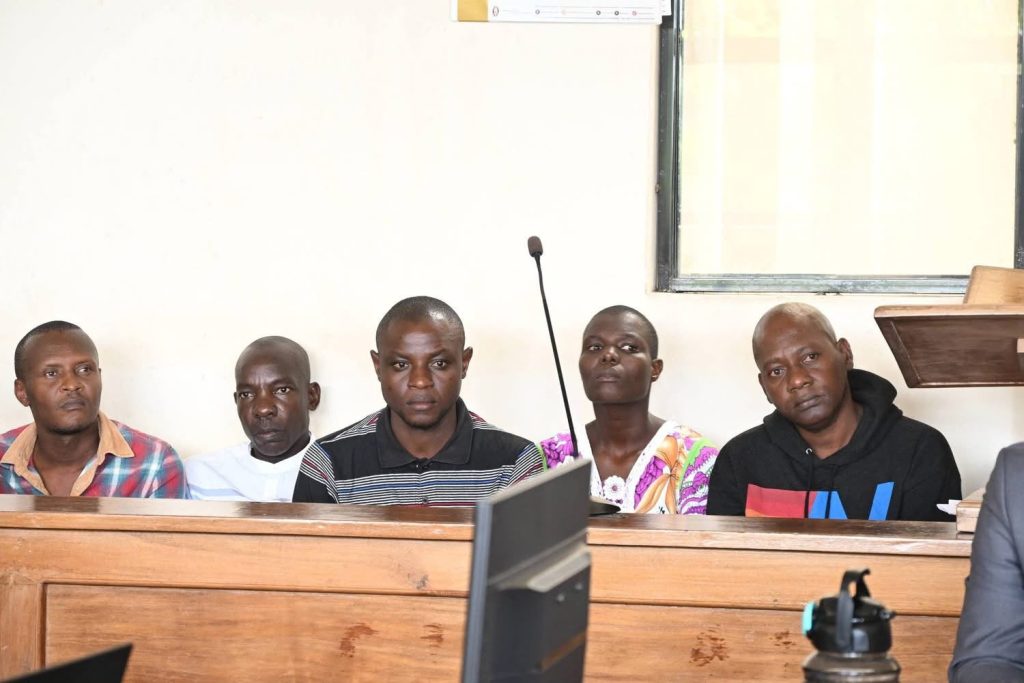
The murder trial involving Pastor Paul Mackenzie and seven co-accused persons continued Monday in the ongoing Kwa Binzaro massacre case, with the prosecution presenting six witnesses before the Malindi High Court.
Testifying before Lady Justice Wendy Kagendo at the Malindi High Court, Salama Masha, gave a harrowing account of how a mobile phone line registered in her name was used to make a call to Pastor Paul Mackenzie while in custody.
According to the witness, she and her family were once members of Good News International Church, which she said discouraged the use of beauty products and cosmetics and formal education as well as seeking treatment in hospitals.
Salama, who identified herself as the wife of the third accused person, Kahindi Kazungu, told the court that they lived in Shakahola “Jangwani” for one year, where they engaged in farming. However, she eventually left Shakahola, as she could not withstand fasting.
Salama told the court that they always had diverse opinions with the husband over the issue of fasting, especially when it came to their children, as the husband advocated for the children fasting while she opposed.
After leaving Shakahola, Salama said that she received news that her husband had died in Shakahola, but she ignored it.
Two years later, the husband returned from Shakahola but later moved to Furunzi in a rented house.
She narrated to the court how she struggled to support her husband and assist him in building his life, but she was always disappointed.
She joined a Chama and used the money acquired to purchase a motorcycle for him to operate a boda boda business.
She further testified that she later acquired a mobile phone SIM card, registered it using her identity card number, and gave it to her husband for use. A decision she said later landed her in trouble.
She told the court that she was once arrested over the allegation that her phone number was used to make a call to Pastor Paul Mackenzie while in custody.
According to the witness, the phone number in question was the same one she had given to her husband.
The court also heard from a 52-year-old Hamisi Abdala, the 35th prosecution witness. Hamisi narrated how the 4th accused person, Julius Tuva, converted her daughter, Nuru Hamisi, from Islamic to Christianity and disappeared with her.
He testified that he initially knew Julius Tuva as a tuk-tuk driver because he used to transport food produce from his farm for a period of 3 years.
He told the court that over time, Tuva developed an interest in marrying his daughter. As a muslim father, he advised Tuva to convert to Islam, as required for a non-Muslim man seeking to marry a Muslim girl.
He noted that after disagreements with the issue of religion, Tuva escaped with her daughter to an unknown place, and he later learnt that the two had been blessed with two children.
Hamisi told the court that he heard that the two were attending a Mackenzie-led church, whose name he could not remember.
After some time, he said that he heard that followers of Mackenzie, of whom he believed her daughter was one of them, had relocated to Shakahola, and some had started dying.
Armed with a photo of her daughter Nuru Hamisi, the witness travelled to Shakahola to look for her daughter but in vain.
“Am convinced that Julius Tuva knows the whereabouts of my daughter Nuru Hamisi.” He told court
He said that he is bitter about the loss of her daughter and would wish to be shown where her daughter is.
The prosecution, also called a 74-year-old, Daniel Baya, a resident of Chakama and chairman of Chakama Ranching Company since 2008, to shed light on the ownership of land around Shakahola.
Baya explained that Chakama Ranching Company was established to manage grazing activities in the area and that the company started with 50 shareholders.
Chakama Ranching Company owned 50,000 acres of land in which villages such as Shakahola, Kwa Binzaro, Ndigiria, and Bovu, among others, exist
According to the witness, around 2021, there were reported cases of suspicious people invading the ranch on the side of Shakahola and starting settlements and farming.
He added that when they visited the homestead of the invaders, they were informed that the team was led by a person by the name of Paul Mackenzie, who was a pastor.
The court heard that the company took a loan of 60 million from Aqua Agro Limited to establish a business but was unable to pay, resulting in the company being placed under receivership.
Another witness, Laymond Korir from the Office of the Official Receiver, corroborated the testimony of Daniel Baya by confirming that when the official from the office of the official receiver visited the ranch, there were pots of homesteads on the ranch.
According to Laymond, the official receiver had not disposed of any property in Chakama Ranch, and anyone buying and selling land within the ranch was doing it illegally.
He confirmed that while the land belonged to Chakama Ranch Company, the property is under the control of the liquidator.
“As far as the official receiver is concerned, there are no legal settlers on the property, and the property ought to be vacant,” the witness said.