
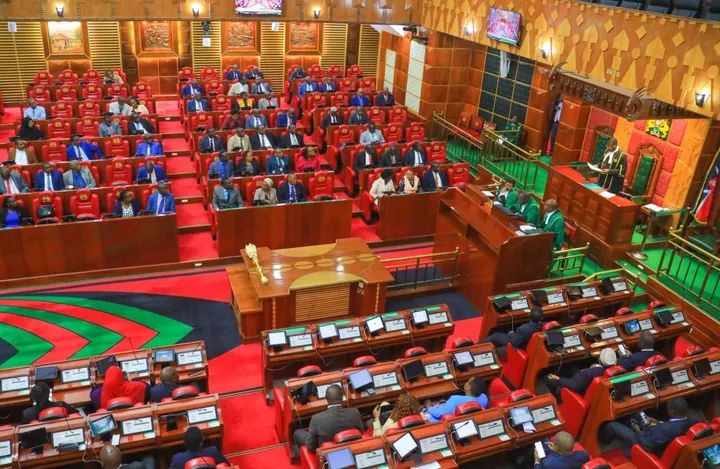
A parliamentary committee Tuesday urged the Ministry of Interior to act decisively against emerging criminal gangs, warning that their resurgence could undermine national security and the integrity of the 2027 General Election.
The National Assembly Departmental Committee on Administration and Internal Security cautioned against a repeat of past election cycles marked by the rise of sectarian groups such as Mungiki and Chinkororo, which were linked to violence in the run-up to the 1992, 1997 and 2007 polls.
Committee chairperson and Narok West MP Gabriel Tongoyo said the State must act early to prevent criminal networks from taking root during the electioneering period.
“We want to see the country secured. We should not allow gangs that have historically thrived during election periods to re-emerge as we head to the 2027 General Election,” said Tongoyo.
He urged security agencies to draw lessons from past crackdowns, citing the firm approach adopted by former Internal Security minister John Michuki.
“You may want to look at what your predecessors, like John Michuki, did to dismantle these gangs. I believe you are equal to the task of securing this country,” he said.
The lawmaker emphasised the urgency of the moment, warning that decisive action is needed ahead of the 2027 General Election.
“You must act now to safeguard the country as we head towards 2027. Under the current circumstances, I am concerned things may not turn out well. This is the critical moment to redeem and secure the nation,” he added.
The remarks were made during a Tuesday session with Interior Cabinet Secretary Onesimus Kipchumba Murkomen, Inspector-General of Police Douglas Kanja and Director of Criminal Investigations Mohamed Amin over the country’s deteriorating security situation.
Lawmakers raised concerns over rising incidents of political violence, banditry and organised crime, pressing the security leadership to outline measures to restore order and safeguard the electoral process.
The committee emphasised the need for a proactive, intelligence-led approach to policing, warning that delayed action could embolden criminal elements.
Saku MP Dido Rasso, the committee’s Vice-Chairperson, pointed to the growing presence of gangs in urban and peri-urban areas, calling for a shift in policing strategy.
“The issue of gangs and goons is increasingly affecting urban and peri-urban areas. Going forward, we must rethink our approach to policing. Policing is dynamic, and we may need specialised units to handle such cases,” said Mr Rasso.
He also highlighted persistent insecurity in parts of the country, including cattle rustling, urging more precise and cost-effective interventions.
“Large-scale operations may not always be necessary. Targeted, intelligence-led interventions can be more effective and ultimately save the government resources,” he added.
Interior Cabinet Secretary Onesimus Kipchumba Murkomen, however, raised alarm over a growing trend of politically instigated violence driven by hired gangs, warning that it could erode democratic gains ahead of the 2027 polls.
He said the increasing normalisation of violence at political rallies is fuelled by the mobilisation of unemployed youth particularly Gen Z who are allegedly paid to disrupt meetings or back rival factions.
“This trend is deeply concerning. It threatens democratic space, erodes public confidence in governance institutions and risks destabilising the country during a politically sensitive period,” said Mr Murkomen.
According to the CS, some of the loosely organised groups have evolved into structured outfits aligned to political interests, posing a serious threat to public order and national cohesion. He said several incidents linked to such networks are under active investigation.
To counter the trend, the National Police Service has stepped up patrols and heightened its presence at political gatherings, especially in identified hotspots, alongside enhanced intelligence gathering to pre-empt violence.
Authorities have also deployed rapid response units and reinforced enforcement of the Public Order Act, which requires organisers of public events to notify police in advance to allow for proper security planning.
The government is working with the National Cohesion and Integration Commission to curb hate speech and inflammatory rhetoric, which officials say often fuels violence.
Murkomen warned politicians against incitement, noting that reckless statements could easily trigger unrest, particularly among vulnerable youth.
He dismissed allegations of police complicity in violent incidents, maintaining that officers operate within the law and remain politically neutral.
“The National Police Service does not and will not collaborate with criminal gangs to enforce order,” he said.
The CS, however, faulted some political actors for failing to comply with the Public Order Act, saying such lapses create security gaps often exploited by rival groups.
In situations where crowd sizes overwhelm local policing capacity, he said, the government activates a multi-agency response involving institutions such as the Kenya Prisons Service, Kenya Wildlife Service and Kenya Forest Service.
Murkomen urged political leaders to uphold the rule of law and embrace peaceful engagement, warning that the continued use of violence as a political tool could have far-reaching consequences for the country’s stability.

If you like our work, you can buy us a soda
Buy us a soda 🥤