

Nairobi Governor Johnson Sakaja has revealed fresh details about the family linked to the multi-storey building that collapsed in Eastleigh, Nairobi, raising serious questions about construction approvals, regulatory enforcement and the professionals involved in the project.
Speaking as rescue operations continued at the site on Saturday, October 24, 2026, Sakaja identified the property as belonging to the estate of the late Wilson Mutia Musyoki and named John Mutia Musyoki as the developer on record.
The governor maintained that Nairobi City County had approved a change of use for the property but had not approved the architectural plans for the proposed building, which had risen to multiple storeys before it came crashing down.
The revelations have intensified scrutiny of the circumstances surrounding the disaster, with authorities under pressure to establish how construction continued despite outstanding approval requirements.
Sakaja Names Family Linked to Collapsed Building
Addressing journalists at the scene, Sakaja said county records indicated that the property belonged to the family of the late Wilson Mutia Musyoki.
“This property is owned by a family. It is the estate of the late Wilson Mutia Musyoki,” the governor said.
According to Sakaja, the county received an application in 2024 seeking permission to change the property’s use from residential to commercial-residential.
That application was approved on October 17, 2024.
However, the governor said a subsequent application seeking permission to construct a 15-storey building with a basement was never approved.
“We’ve looked at the documentation. They had applied in 2024 for a change of use. That was granted. Then an application was made through one John Mutia Musyoki, who is the developer on record. That application was to do 15 plus basements. The application was never granted, meaning there is no approval for this construction,” Sakaja stated.
His remarks suggest a significant distinction between permission to change how land is used and approval to construct a specific building on it.
The governor’s account has raised questions about how the project progressed despite the county’s position that the proposed architectural plans had not received approval.
Governor Questions How Construction Continued
Sakaja further disclosed that the county’s Urban Planning Committee had raised concerns about aspects of the proposed development, including plans for shops in the basement and on the ground floor.
He said architectural plans submitted on November 20, 2024, were not approved, yet construction continued.
The governor also indicated that the county had issued an enforcement order earlier in 2026 after concerns about unauthorised construction emerged.
The revelations have put the spotlight on the effectiveness of Nairobi’s building inspection and enforcement systems, particularly in densely populated commercial neighbourhoods where construction and business activities often take place side by side.
Sakaja questioned whether existing penalties were strong enough to discourage developers from disregarding construction regulations.
“Now if somebody is building something like this and they are asked to pay a fine of 5,000 or a small arrest for a weekend and to go back to constructing, what more can then be done?” he asked.
He argued that minor penalties and delays in prosecuting construction-related offences could undermine the county’s efforts to enforce planning regulations.
The governor also called for county governments to regain prosecutorial powers, saying stronger enforcement mechanisms were necessary to ensure that developers comply with the law.
Sakaja Names Professionals Linked to the Project
Beyond identifying the developer on record, Sakaja called on professional bodies to investigate the architects, engineers, planners and other individuals whose details appeared in documents associated with the development.
County records cited by the governor identified architect Emmanuel Mwangi Maina and structural engineer Joseph Muturi Mugu among the professionals linked to the project.
Precise Civil Engineering Limited was also associated with the civil and structural engineering submission, while Stromax Holdings E.A. Limited was listed as the contractor.
Sakaja insisted that professional responsibility must be examined alongside the actions of the developer and the relevant government agencies.
“The architect on record needs to answer as to how his client went on to start construction and continue construction without any approval,” the governor said, according to .
He urged the professional associations representing architects, engineers, quantity surveyors and builders to investigate whether their members had complied with their legal and professional obligations.
The governor also described the incident as a case of “total impunity”, arguing that those found culpable should face appropriate disciplinary or legal consequences.
However, the individuals and companies named in project records have not been conclusively found responsible for the collapse.
Investigations will need to establish their respective roles and whether any violations contributed to the disaster.
County Forwards Report to DCI
Sakaja said Nairobi City County had forwarded its documentation on the development to the relevant authorities, including the Directorate of Criminal Investigations (DCI), for further investigations.
He called for accountability across both levels of government, saying action should not be limited to private developers if public officers are also found to have failed in their responsibilities.
“We want to see action taken, you know, by the police, by the DCI, and the documentation has been forwarded to them by the county, because that is, you know, the procedure that we have,” he stated.
The governor also renewed his campaign for county governments to regain prosecutorial powers, arguing that the current system makes it difficult to respond effectively to construction violations.
He said Nairobi had more than 200 construction-related files pending at the Director of Public Prosecutions’ office, raising concerns about delays in taking action against suspected offenders.
Sakaja warned that the county would intensify enforcement against unauthorised developments and take action against structures found to require removal in accordance with the law.
Seven People Reported Missing After Collapse
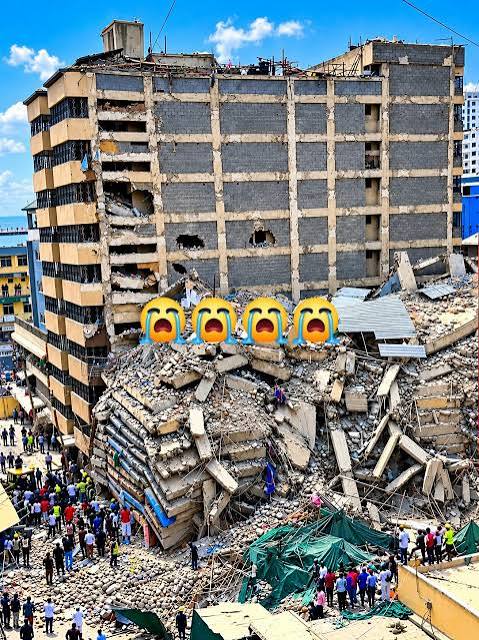
The revelations came as emergency responders continued searching for people who may have been trapped when the building collapsed along 9th Street in Eastleigh on Friday, October 23.
According to Interior Cabinet Secretary Kipchumba Murkomen, 67 construction workers were at the site when the incident occurred. Sixty-six escaped without injuries, while one sustained injuries and was taken to hospital.
Murkomen also said seven people had been reported missing, with rescue teams working to reach those believed to be beneath the rubble.
Eleven shops on the ground floor and in the basement were occupied when the building came down.
The rescue operation brought together multiple agencies, including the Kenya Defence Forces, National Police Service, Nairobi City County Government, National Youth Service and Kenya Red Cross.
The incident has raised concerns about the safety of traders, construction workers and members of the public in densely populated commercial areas.
Eastleigh is one of Nairobi’s major commercial centres, with busy streets lined with shops, wholesale businesses and residential developments.
The collapse has therefore affected not only the construction sector but also the wider business community.
Fresh Questions Over Building Safety in Nairobi
The tragedy has renewed calls for stronger inspections, transparent approval processes and stricter enforcement of building regulations.
The National Construction Authority identified 9th Street Plaza Limited as the developer in its records, with Stromax Holdings E.A. Limited listed as the contractor.
Its records also named the architect and structural engineer associated with the project.
The authority’s project records and Sakaja’s account of the county’s approval process have raised questions about how different regulatory requirements were handled.
The precise cause of the collapse, however, remains subject to investigation.
The disaster has also prompted calls from political leaders for those found responsible to face consequences.
Saboti MP Caleb Amisi called for stricter enforcement of building regulations, comprehensive safety audits and accountability for negligent parties.
For Sakaja, the immediate task is to support rescue efforts while ensuring that investigations establish how the building was allowed to progress despite the county’s stated concerns.
His latest revelations have placed the property’s ownership, the developer’s role and the conduct of professionals and regulators at the centre of the unfolding investigation.
Authorities are yet to establish the definitive cause of the collapse or determine individual criminal responsibility.
The findings of the investigations will be critical in deciding whether further legal action is warranted and what measures are needed to prevent similar tragedies in Nairobi.
For families awaiting news of missing relatives, the priority remains the search for survivors.
For the wider public, the incident has become another urgent test of whether building regulations can be enforced effectively before lives are put at risk.
FOLLOW NAIROBI NEWS ON FACEBOOK

If you like our work, you can buy us a soda
Buy us a soda 🥤