The government has reaffirmed its commitment to enhancing network infrastructure and communication services in underserved and high-risk regions across the country, with a particular focus on Turkana County.
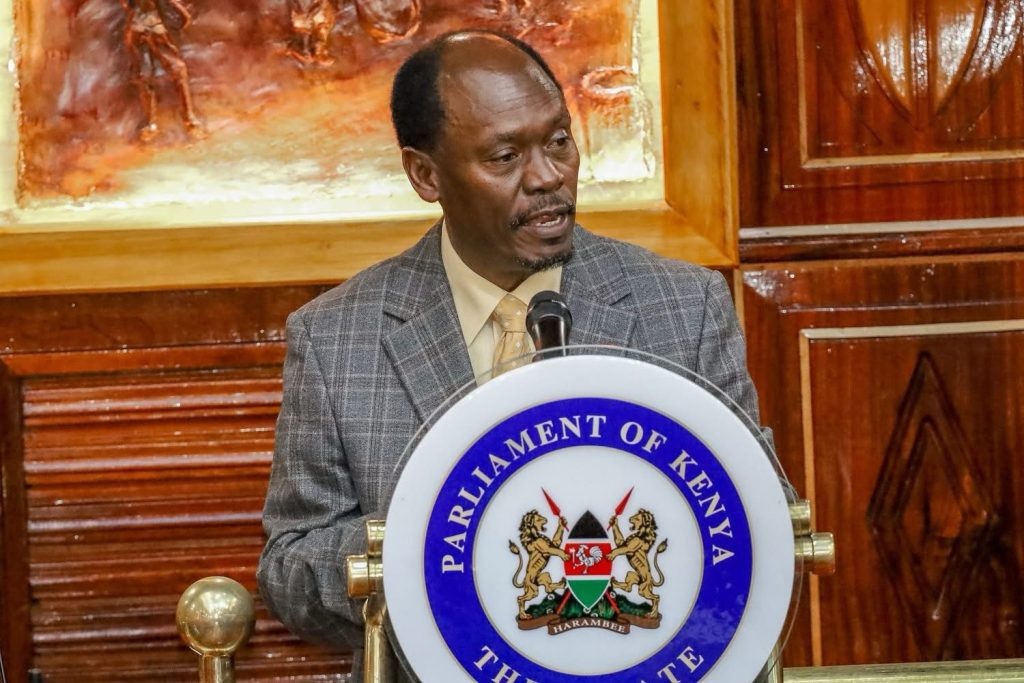
This assurance was delivered on Wednesday during a Senate plenary session by Cabinet Secretary for Information, Communications, and the Digital Economy, William Kabogo.
He was responding to questions led by Turkana Senator James Lomenen, who sought clarity on the government’s efforts to improve connectivity in remote and insecure border regions.
Senator Lomenen highlighted the need for reliable communication to support the operations of the Kenya Defence Forces (KDF), National Police Reservists (NPR), and local communities, particularly in areas such as Todonyang, Merikuka, Natete, Lopeimukat, and Natira.
In his response, CS Kabogo noted that the Communications Authority of Kenya (CA), through the Universal Service Fund (USF), had successfully established a mobile tower in Todonyang.
The tower is operational, providing mobile coverage to surrounding areas, including over 80% coverage in Natira Sub-location.
“To secure our borders and protect our communities, communication is critical.
That is why we are prioritizing network connectivity in Turkana through initiatives supported by the Universal Service Fund,” Kabogo told the Senate.
He added that the ministry is conducting Quality of Service (QoS) assessments in these regions to guide future collaborations with mobile network operators and address ongoing service gaps.
While acknowledging progress, several Senators including Danson Mungatana (Tana River), Fatuma Dullo (Isiolo), Wafula Wakoli (Bungoma), Enoch Wambua (Kitui), and Julius Murgor (West Pokot) expressed concern over the pace of implementation.
They called on the Ministry to accelerate the deployment of communication infrastructure, particularly in regions plagued by insecurity and poor access.
Addressing inquiries about cooperation with major telecom providers like Safaricom and Airtel, Kabogo confirmed ongoing partnerships.
He said that under USF Phase II, mobile infrastructure had been installed in 10 out of 18 targeted sub-locations in Turkana, significantly boosting mobile service access.
“Communication is not a luxury it’s a necessity for both communities and our security agencies. We are working to make this a reality across Turkana,” Kabogo added.
Regarding secure communication for the KDF and NPR, the CS said exclusive frequency allocations are made available to security agencies upon request, ensuring interference-free communication for operations.
As a short-term measure, Kabogo said field assessments would be conducted to identify specific communication needs in affected areas and implement interim solutions ahead of permanent infrastructure deployment.
During supplementary questioning, Senators raised further concerns over the slow rollout of network infrastructure, especially in remote border regions.
In response, Kabogo outlined the government’s broader strategy, which includes the rollout of 100,000 kilometres of fibre optic cable to enhance national connectivity.
“The Fibre Optic project will deliver fast, reliable internet to every corner of the country,” Kabogo said.
He also revealed that the government is working with satellite providers, including Starlink, to improve mobile connectivity in remote and insecure locations.
Senator Edwin Sifuna (Nairobi) questioned the continued reliance on private firms for major connectivity projects, asking why Telkom Kenya was not tasked with rolling out the National Fibre Optic network.
Kabogo explained that Telkom Kenya faced operational challenges that limited its capacity to undertake such projects, prompting the government to engage alternative providers.
High communication costs were another key issue raised by Senators Boni Khalwale (Kakamega) and Julius Murgor (West Pokot). Kabogo acknowledged the concern and promised a detailed response at a later date.
Deputy Speaker and Meru Senator Kathuri Murungi pressed for transparency regarding the management and use of the Universal Service Fund, asking for a detailed breakdown of its expenditure and geographic impact.
“That fund is deducted from Kenyans with every call they make. Is it being used prudently and equitably?” Murungi asked.
Kabogo assured the House that the fund is secure and being used appropriately to extend communication services to underserved regions.
Finally, Senators Karungo Thang’wa (Kiambu) and Richard Onyonka (Kisii) raised questions about integrating emerging technologies such as Artificial Intelligence and ChatGPT into the national education curriculum.
Kabogo confirmed that the Ministry is working closely with the Ministry of Education to equip students with the digital skills necessary for a rapidly evolving global landscape.

If you like our work, you can buy us a soda
Buy us a soda 🥤