
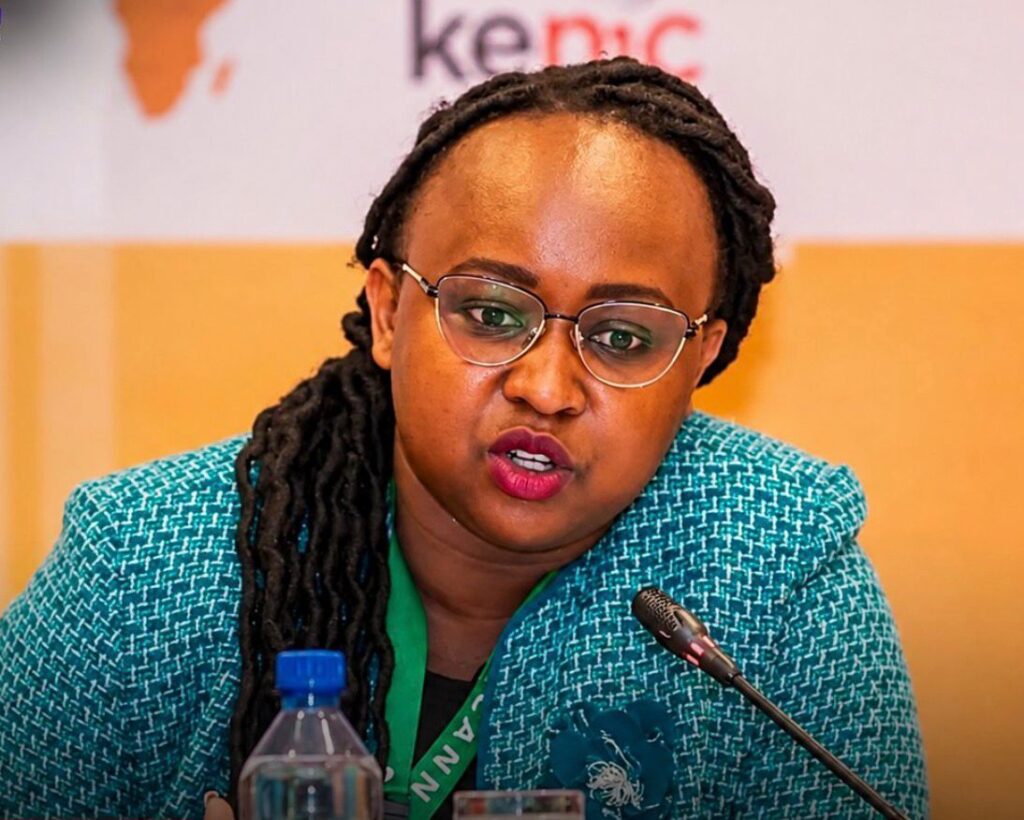
The husband of late KCB senior executive Rosemary Chemutai Koech told the court that he will not seek the exhumation of his wife’s body and has instead opted to withdraw his case against his in-laws.
Through his lawyer, Kevin Kimwatu said that although exhumation remained an option following the circumstances surrounding Chemutai’s burial, he was unwilling to pursue it.
His lawyer told the court that Kimwatu had decided to leave what happened on the night of the burial “to God”, despite having been denied an opportunity to mourn his wife.
Kimwatu instead asked to be allowed to visit Koech’s gravesite together with his children and other family members on a day convenient to the family.
He will also not pursue contempt proceedings arising from the dispute, with his lawyer describing the decision to withdraw the case as part of a journey towards reconciliation between the two families.
The court was told that the dispute had been a sad chapter for everyone involved, with Kimwatu expressing hope that the bonds that had tied the families together for more than 20 years could eventually be mended.
Koech, who served as head of data protection in KCB’s risk division, died by suicide on August 21 at the age of 40 at a house she lived in with her children in Ngong, Kajiado County, following a strained relationship with her husband, Kevin Migwe Kimwatu.
A Nairobi court had earlier on Friday temporarily stopped the burial and ordered Lee Funeral Home not to release the body pending the hearing and determination of a case filed by her husband.
The body had however been moved on August 25.
Senior Principal Magistrate Agnes Mwangi of the Milimani Court in Nairobi issued interim orders on Friday restraining the family, Lee Funeral Home and KCB from moving the body of the deceased. She also barred the family from conducting the burial without the consent of the deceased’s husband.
However, the burial was conducted at around 7.30pm at Chepseon village in Kipkelion East Constituency, Kericho County.
Clan chairman Samwel Keter, who is also a relative, explained on Saturday why.
“What’s being circulated on social media is not true; they are just pushing an agenda.
Our daughter died the way she did (by suicide, and in our culture, that means you are not supposed to stay unburied tor more than three or four days.
“Also, when a post-mortem is conducted, a funeral has to happen within two days. We did whatever we did because of our culture so that something like that (suicide) will not happen again. Maybe that’s why people are saying whatever they are saying. We did that according to the Kalenjin culture, not just Kipkendek (the name of the clan) culture,” Keter said.
“Bodies used to be buried at night among members of the Kipsigis community; that is why, in the current generation, the final ceremony is done late in the evening. It is an old-age tradition,” he said.
He said that in the event a parent insists on burying their daughter, who had been married off because of existing and unresolved differences with the spouse, they should return the dowry that was paid to them as a result of the marriage.
He said police investigations and postmortems had complicated the traditional practice of conducting funerals promptly.
“There is nothing wrong with holding a service atter one has been buried, as it is within the mourning window for the immediate family, he said.
It has also emerged that the body was moved from Nairobi to Kericho on August 25 as a tussle ensued between Koech’s parents and her husband, Kevin Kimwatu, with whom she had a sour relationship.
If you like our work, you can buy us a soda
Buy us a soda 🥤