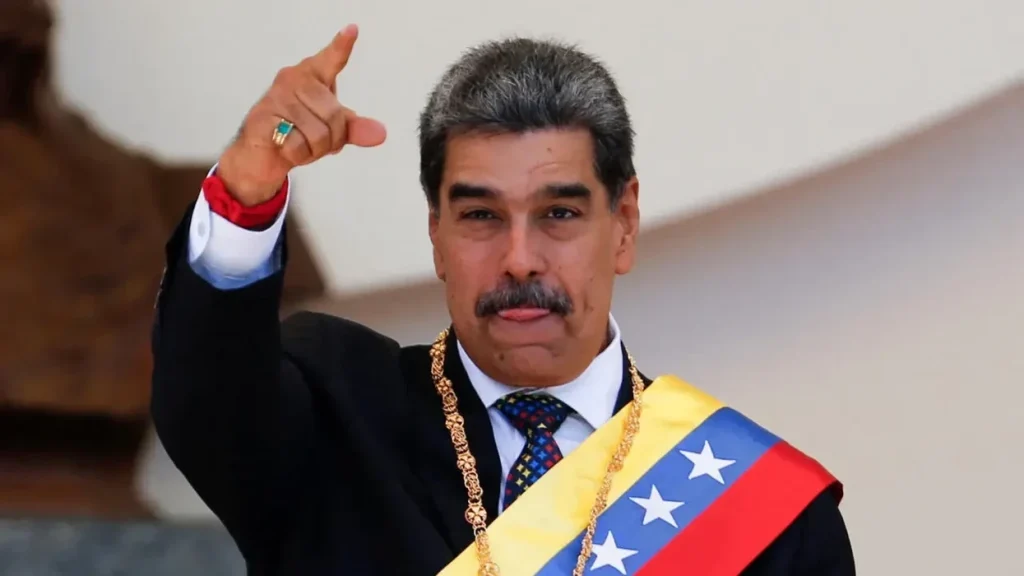
The U.S. capture of Venezuelan President Nicolas Maduro, described by President Donald Trump as a “stunning and powerful” move, has triggered uncertainty over who is now in charge of the oil-rich nation.
Trump said on Saturday that Vice President Delcy Rodríguez had been sworn in following Maduro’s arrest and had spoken with U.S. Secretary of State Marco Rubio, fueling speculation that she would assume leadership.
Under Venezuela’s constitution, Rodríguez would become acting president in Maduro’s absence, and the country’s top court ordered her to take on the role late Saturday night.
However, shortly after Trump’s remarks, Rodríguez appeared on state television alongside National Assembly head Jorge Rodríguez, Interior Minister Diosdado Cabello, and Defense Minister Vladimir Padrino López, insisting that Maduro remained Venezuela’s only president.
The joint appearance signaled that the powerful inner circle that governed alongside Maduro remains unified, at least for now.
Trump also ruled out working with opposition leader and Nobel Prize laureate Maria Corina Machado, saying she lacks sufficient support inside Venezuela.
Machado was barred from running in the 2024 elections, though international observers say her replacement candidate won decisively, despite the government declaring Maduro the victor.

For more than a decade, Venezuela’s real power has rested with a small group of senior civilian and military officials.
Analysts say the system relies on loyal networks, security agencies, and control over key institutions.
Within this structure, Rodríguez and her brother represent the civilian wing, while Cabello and Padrino López anchor the military side.
Experts note that this balance of power makes dismantling the current system far more complex than simply removing Maduro.
“Removing one figure does not change the system,” said a former U.S. official familiar with investigations into Venezuela.
Attention has increasingly focused on Interior Minister Diosdado Cabello, a senior socialist party figure with influence over security and intelligence agencies.
Analysts describe him as a central and hardline figure within the regime.
International investigations have previously accused Venezuela’s intelligence services of serious human rights violations as part of efforts to suppress dissent.
In recent weeks, amid a significant U.S. military buildup in the region, Cabello has appeared on state television issuing tough warnings against dissent and vowing strong action against perceived threats.
He has also been linked to pro-government civilian groups that support the ruling establishment.
Although Defense Minister Padrino López has formally led the armed forces for over a decade, Cabello is believed to command loyalty from a significant portion of the military.
Venezuela has an unusually large number of senior officers, many of whom oversee key economic sectors, including food distribution and the state oil company, PDVSA.
According to analysts and legal sources, some senior officials may be considering cooperating with the United States in exchange for protection or legal guarantees.
However, people close to Cabello say he has shown no interest in negotiating, underscoring the uncertainty surrounding Venezuela’s political future following Maduro’s capture.

If you like our work, you can buy us a soda
Buy us a soda 🥤