
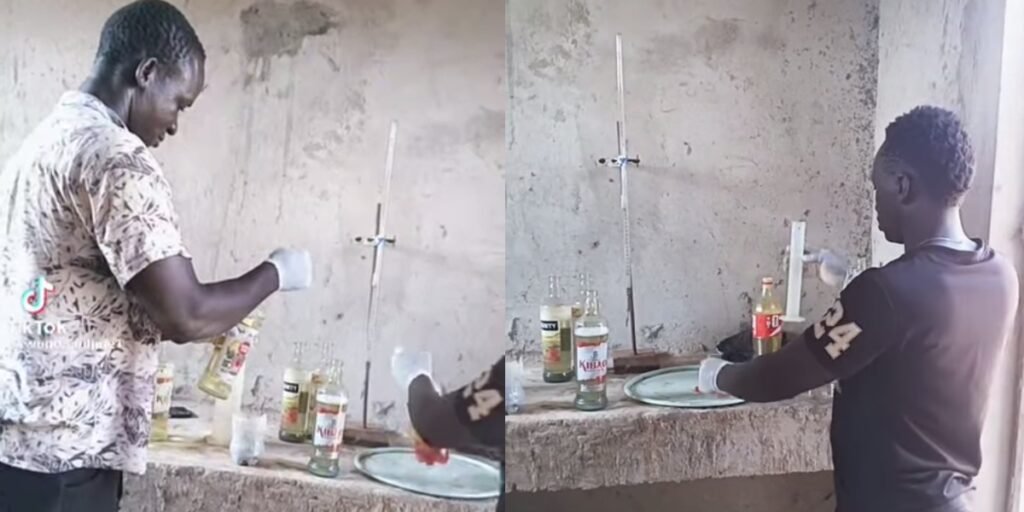
A disturbing video showing what appears to be suspected counterfeit liquor being prepared and bottled in a makeshift setting has triggered fresh concern among Kenyans over the growing trade in illicit alcoholic drinks.
The footage, which has been circulating online, appears to show individuals handling liquor in an informal environment before placing it into bottles and preparing the products for distribution.
The circumstances surrounding the recording, including its exact location and the identities of those involved, have not been independently established.
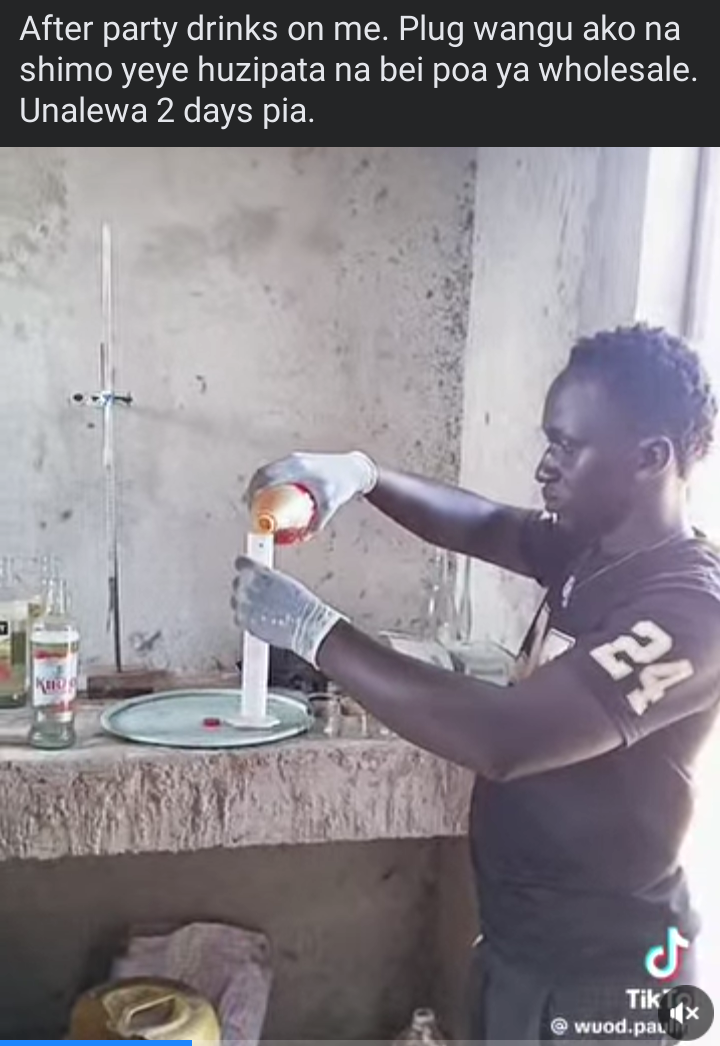
However, the images have reignited a wider national debate about the safety of alcoholic drinks reaching consumers through informal and illicit supply chains.
Kenyans alarmed by the footage
The video has particularly unsettled social media users because of the apparent lack of hygiene and professional production equipment visible in the footage.
Concerned Kenyans questioned how such products could make their way into shops, bars and other entertainment establishments without being detected.
Some called for authorities to trace the source of the products and establish whether the operation was part of a larger counterfeit alcohol network.
Others expressed concern that unsuspecting consumers could easily mistake counterfeit products for genuine brands, particularly when criminals reuse genuine bottles, labels and tax stamps.
The concerns are not without basis.
Recent investigations by several Kenyan media outlets reported that counterfeiters in Kenya have been collecting genuine branded bottles, replicating labels and security seals and even cloning KRA tax stamps before filling the containers with cheap or potentially dangerous liquor.
Fresh evidence of a much bigger problem
The video emerges at a time when Kenyan authorities are intensifying their crackdown on illicit alcohol.
Just days before the video began attracting attention, DCI detectives and Kenya Revenue Authority officials recovered more than 300 cartons containing thousands of suspected counterfeit spirits in Thika.
According to NTV Kenya, the products had been packaged in bottles bearing the names of several popular alcoholic brands.
Investigators also recovered empty bottles, hundreds of litres of ethanol and suspected counterfeit revenue stamps during a raid at a residential property in Makongeni, Thika.
The discovery has heightened fears that some counterfeit alcohol operations may involve organised networks rather than isolated backyard producers.
The Anti-Counterfeit Authority has previously told Parliament that illicit alcohol remains a significant challenge in Kenya, with counterfeiters exploiting genuine bottles, fake labels and other methods to deceive consumers.
The authority also identified porous borders, diversion of ethanol and online distribution as some of the challenges complicating enforcement.
Thousands of litres seized in recent raids
The scale of the problem has also been demonstrated by recent enforcement operations.
On August 21, 2026, NACADA said it seized more than 27,000 litres of illicit alcohol during coordinated operations in Nairobi and Nyakach.
In Dagoretti North alone, officers recovered 2,130 litres of chang’aa and 120 drums of kangara containing an estimated 25,200 litres.
Earlier this year, a nationwide crackdown had already resulted in the seizure of more than 2.8 million litres of illicit alcohol and the arrest of hundreds of suspects, according to government figures reported in April.
These figures have raised questions over whether Kenya is dealing with a deeply entrenched illicit alcohol economy capable of continuously replacing products seized by authorities.
Why counterfeit alcohol is particularly dangerous
Unlike legitimate manufacturers, operators producing alcohol in uncontrolled environments may not have reliable systems for testing the ingredients, alcohol concentration or contaminants in their products.
The danger becomes even greater when industrial chemicals or improperly handled ethanol enter the production process.
Experts have warned about the dangers of adulterants such as industrial methanol, which can cause severe poisoning, including damage to the optic nerve and other organs.
For consumers, the biggest challenge is that counterfeit products can sometimes look remarkably similar to genuine ones.
A reused bottle carrying an authentic-looking label and a convincing tax stamp may give a buyer a false sense of security.
‘How many people have already consumed this?’
That question has been among the strongest sentiments expressed by concerned Kenyans reacting to the footage.
Some online users questioned whether authorities should investigate not only the people visibly involved in bottling suspected counterfeit liquor, but also the distributors, suppliers, financiers and outlets that may facilitate the movement of such products.
Others argued that enforcement should go beyond occasional raids.
There were also calls for stronger surveillance of alcohol outlets and tougher action against businesses found selling counterfeit or adulterated drinks.
The reactions reflect a growing frustration among members of the public who believe consumers should not have to become forensic experts simply to determine whether a bottle of alcohol is genuine.
Authorities urged to act on viral evidence
NACADA’s enforcement directorate is mandated to monitor alcohol production, sale and distribution, coordinate intelligence-led enforcement operations and seize suspected counterfeit alcoholic products.
It also collects samples for laboratory analysis and responds to public complaints.
The agency provides a 24-hour toll-free helpline, 1192, for reporting incidents and seeking assistance.
This means the viral video could potentially become useful investigative material if authorities can establish where and when it was recorded and identify the people involved.
However, officials would need to authenticate the footage and subject any recovered liquid to laboratory testing before conclusively determining that it is counterfeit, adulterated or unsafe.
A problem bigger than the bottle
The counterfeit alcohol crisis is increasingly being viewed as both a public-health and economic problem.
Illicit operators avoid many of the costs borne by legitimate manufacturers, including taxes, licensing, quality-control systems and compliance requirements.
This allows illegal products to be sold at significantly lower prices.
At the same time, legitimate manufacturers can suffer reputational damage when counterfeit products are sold using their brands.
The Anti-Counterfeit Authority has said illicit alcohol accounted for a substantial share of Kenya’s alcohol market by volume, while recent industry research cited by The Star estimated the wider illicit alcohol market at about Sh203 billion.
Kenyans demand answers
For many Kenyans, the viral video has therefore become more than another disturbing clip on social media.
It has raised an uncomfortable question: How much illicit alcohol is being produced and sold to unsuspecting consumers without their knowledge?
Concerned members of the public are calling for authorities to establish the origin of the operation depicted in the footage, determine whether the products reached the market and prosecute anyone found responsible.
The public reaction also underscores the need for consumers to remain cautious, particularly when purchasing alcohol from unfamiliar outlets or when a product is being sold at a price that appears unusually low.
Until the footage is independently authenticated and the substances involved are scientifically tested, claims that the video conclusively depicts counterfeit or poisonous liquor remain allegations.
But the outrage it has generated is a reminder that Kenya’s battle against illicit alcohol is far from over.
FOLLOW NAIROBI NEWS ON FACEBOOK