Rio Tinto’s net worth emerges from its mining business. It is a British-Australian multinational mining company headquartered in London, England, and Melbourne, Australia.
Rio Tinto net worth 2026
The estimated Rio Tinto net worth/market capitalisation is $65.85 billion as of September 4, 2026, according to the Australian Securities Exchange (ASX). Additionally, it generated a revenue of $57.63 billion in 2025. For the same financial year, Rio Tinto generated $16.8 billion in net cash from operating activities and $10 billion in profit after tax attributable to its owners.
Company overview
Rio Tinto is one of the world’s largest mining and metals companies, with a history stretching back more than 150 years. Established in 1873, the company takes its name from the Rio Tinto copper mine in Andalusia, Spain, which had been worked for thousands of years before English investors acquired and redeveloped it.
Today, Rio Tinto operates in 34 countries across six continents and employs more than 61,000 people, supplying metals and minerals that are essential to modern economies and the global energy transition.
Its portfolio includes iron ore, aluminium, bauxite, alumina, copper, lithium, diamonds, titanium dioxide, salt and borates.
The company’s core business is extracting, processing and supplying natural resources used in construction, manufacturing, transportation and clean-energy technologies.
Iron ore is used to produce steel for infrastructure, copper is essential for electricity networks, renewable-energy systems and electric vehicles, while aluminium is valued for lightweight applications such as cars and smartphones. Lithium is increasingly important for batteries and energy storage.
Rio Tinto has also positioned innovation and decarbonisation as important parts of its strategy, developing technologies such as ELYSIS, which aims to enable carbon-free aluminium smelting, and using automation, artificial intelligence, machine learning and data science to improve mining productivity, safety and efficiency.
Innovation has been part of Rio Tinto’s development since its earliest years. The company has pioneered the use of automated trucks, trains and drills as well as remote operations, while its research has helped identify new deposits, recover valuable materials from waste and extend the life of existing assets.
One notable achievement was becoming the first producer of scandium oxide in North America, extracting the high-purity material from waste streams without additional mining.
Rio Tinto has also committed $150 million over 10 years to the Rio Tinto Centre for Future Materials at Imperial College London, supporting research into more sustainable ways of producing, using and recycling materials needed for the energy transition.
Sustainability and community partnerships are also central to the company’s operations. Rio Tinto has set a goal of reducing emissions from its operations by 50% by 2030 and is developing lower-carbon products and production methods.
Among its more recent achievements, Rio Tinto recorded 8% growth in copper-equivalent production in 2025, driven partly by the ramp-up of the Oyu Tolgoi underground copper mine in Mongolia and strong production across its portfolio.
Its Pilbara operations achieved record iron-ore production, while the company also recorded strong bauxite and lithium performance.
In 2026, Rio Tinto marked another major milestone when it shipped its 8 billionth tonnes of iron ore from Western Australia’s Pilbara region, six decades after its first shipment from the region.
The company also celebrated 60 years of operations in Western Australia in August 2026, highlighting the development of the Pilbara into one of the world’s major mining regions.
Recognitions
Its environmental initiatives have received external recognition. In 2025, the company’s Diavik Diamond Mine received the Towards Sustainable Mining Environmental Excellence Award for its 3.5-megawatt solar power plant, which was designed to supply up to 25% of the site’s power needs during closure and reduce diesel consumption and carbon emissions.
Rio Tinto’s Iron Ore Company of Canada also received the same environmental award in 2024 for a partnership focused on rehabilitating abandoned sites in the Innu ancestral territory.
Other recognitions include Forbes’:
- Global 2000 (2011, 2012, 2013, 2014, 2015, 2016, 2017, 2018, 2019, 2020, 2021, 2022, 2023, 2024, 2025, 2026)
- Canada’s Best Employers For Company Culture – Construction, Chemicals, Raw Materials (2026)
- World’s Top Companies for Women – Construction, Chemicals, Raw Materials (2024, 2025)
- Canada’s Best Employers – Construction, Oil & Gas Operations, Mining and Chemicals (2021, 2022, 2023, 2024, 2025, 2026)
- Global 2000: United Kingdom – Materials (2025)
- World’s Best Employers – Construction, Oil & Gas Operations, Mining and Chemicals (2021, 2022, 2023, 2025)
- Canada’s Best Employers (2017, 2018, 2019, )
- World’s Best Employers – Diversified Metals & Mining (2019, 2020)
- Top Multinational Performers – Diversified Metals & Mining (2017)
Conclusion on Rio Tinto net worth
Overall, Rio Tinto’s wealth stems from its globally diversified mining assets, long-term commodity sales, large-scale production operations and investments in minerals critical to industrial development and the energy transition. Its scale, technological expertise and extensive resource base have allowed it to remain a major player in the global mining industry while increasingly focusing on copper, aluminium and lithium alongside its iron-ore business.
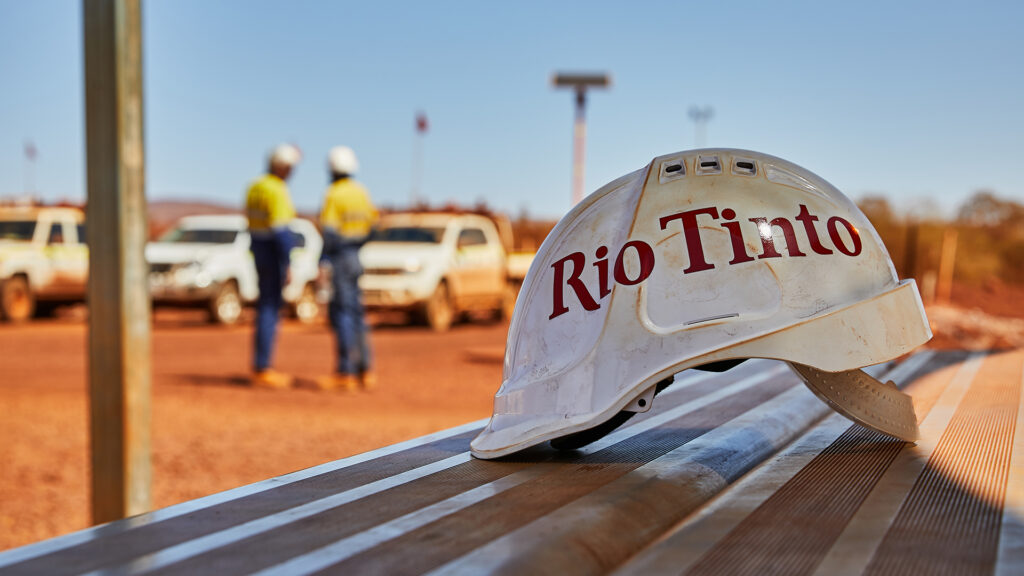
Featured image: Rio Tinto on riotinto.com
If you like our work, you can buy us a soda
Buy us a soda 🥤