

Embakasi East Member of Parliament Babu Owino has intensified the controversy surrounding the collapse of a multi-storey building in Nairobi’s Eastleigh after releasing documents he claims show that the development received county approval in February 2024, directly challenging Governor Johnson Sakaja’s account of the project’s authorisation.
In an explosive statement, the legislator accused the Nairobi governor of misleading Kenyans about the building’s approval status and alleged that Sh 120 million had changed hands in connection with the development.
The accusations have sparked fresh questions about Nairobi County’s construction approval procedures, the enforcement of building regulations and the accountability of officials responsible for overseeing developments in the capital.
The building collapsed on Friday, October 23, 2026, triggering an emergency rescue operation and renewed scrutiny of the circumstances under which the structure was constructed.
Babu took to Facebook on Sunday, October 25, to share what he described as evidence contradicting the county administration’s explanation of the building’s approval history.
In his statement, the MP said;
“Sakaja lied to Kenyans that the building in Eastleigh that collapsed had no approval. I have posted the approval that was done on February 13, 2024.”
He went on to criticise the governor’s leadership, describing the situation as a joke and raising questions about the alleged Sh 120 million payment.
However, the bribery allegation remains unverified, and the document published by Babu does not, by itself, establish that money was paid to any official or that a criminal offence occurred.
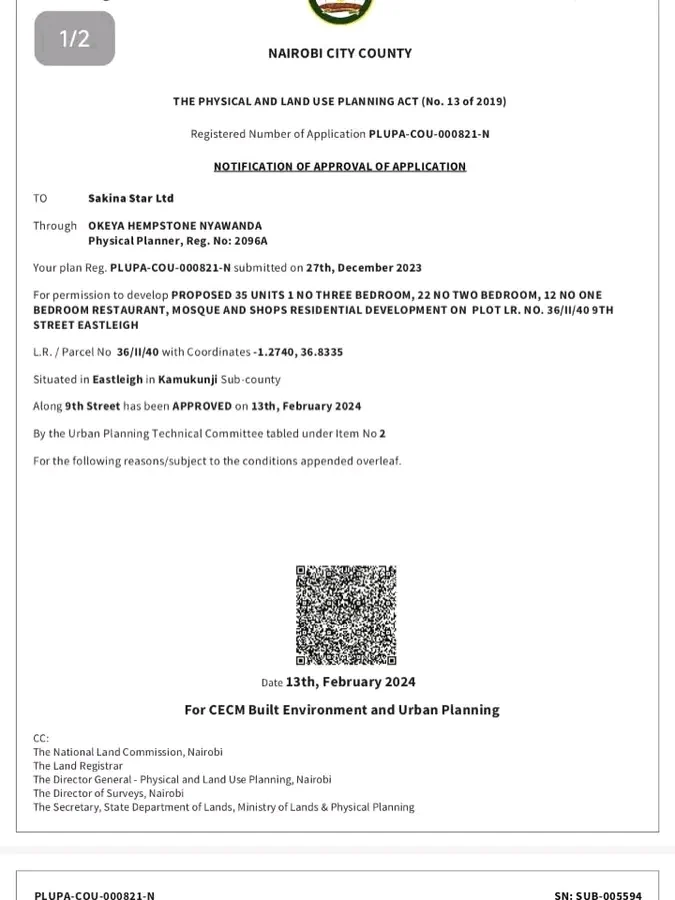
According to the document shared by the legislator, the application was approved on February 13, 2024, by the Urban Planning Technical Committee under Item Number Two.
The paperwork bears Application Number PLUPA-COU-000821-N and identifies Sakina Star Ltd as the applicant.
The document references Plot LR No. 36/II/40, located along 9th Street in Eastleigh, within Nairobi’s Kamukunji Sub-county.
It describes a proposed development comprising 35 residential units, a restaurant, a mosque and shops.
The residential component reportedly included one three-bedroom apartment, 22 two-bedroom apartments and 12 one-bedroom apartments.
Babu used the document to challenge the county administration’s position, arguing that the approval records should prompt authorities to explain what was authorised and how the development progressed.
The controversy, however, centres on an important distinction between approval for a change of use and approval of architectural and structural plans for the actual construction.
Sakaja has maintained that the county approved a change of use on October 17, 2024, allowing the property to transition from residential use to commercial-residential use.
According to the governor, architectural plans submitted on November 20, 2024, were not approved.
The governor has also stated that the building rose beyond the proposed 15 floors, reaching 18 floors before it collapsed.
He said the county had attempted to intervene after identifying unauthorised construction and that relevant reports had been forwarded to investigative authorities.
These competing accounts have left questions about the scope of the documents released by Babu and whether the approvals covered every aspect of the project.
Establishing the truth will require investigators to examine the original application, approved drawings, structural plans, inspection reports and any enforcement notices issued during construction.
The National Construction Authority (NCA) and the National Environment Management Authority (NEMA) have also come under scrutiny over their respective roles in the development.
Reports by Citizen Digital indicated that NEMA had not issued an environmental impact assessment licence for the project after the developer reportedly failed to provide revised, clear architectural drawings requested by the authority.
The NCA, meanwhile, reportedly stated that the development had been registered on July 30, 2025. Questions subsequently emerged after the project details were reportedly unavailable on the authority’s public portal shortly after the collapse before appearing online.
Government spokesperson Charles Owino also raised concerns about discrepancies in the approval process, saying plans submitted by developers still required amendments.
He called for improved coordination between Nairobi County, the NCA and NEMA, including a shared digital platform through which the agencies could verify development records.
The issues raised by the various officials do not, on their own, establish that documents were forged or that a particular agency caused the collapse.
Those matters require independent verification through the ongoing investigations.
Meanwhile, rescue teams have been working to establish whether anyone remains trapped beneath the rubble.
The collapse occurred in Eastleigh, one of Nairobi’s busiest commercial neighbourhoods, where residential buildings, shops and other businesses operate in close proximity.
The Associated Press reported that one man was rescued from the debris on Saturday, October 24, and taken to hospital.
The Kenya Red Cross had also reported 31 people missing, although the figures were still being verified.
Emergency responders deployed sniffer dogs and thermal sensors as they searched through the rubble.
The incident disrupted business activities in the surrounding area, with traders facing uncertainty as authorities secured the site and rescue operations continued.
The tragedy has renewed concerns about construction safety in Nairobi, particularly in densely populated neighbourhoods where high-rise developments have become increasingly common.
Building regulations are intended to ensure that developments meet approved designs, comply with structural safety standards and undergo the necessary inspections.
When different agencies are responsible for planning permission, environmental compliance and construction oversight, effective coordination becomes essential.
Babu’s allegations have now added a political dimension to the disaster, with the MP demanding accountability from the county leadership while Sakaja maintains that the architectural plans were not approved.
The alleged Sh 120 million bribe is a particularly serious claim that requires credible evidence and investigation before responsibility can be assigned to any individual.
Equally, the existence of a planning document does not automatically establish that a building complied with every requirement governing its construction.
As investigators examine the developer’s records and the approvals issued by the relevant agencies, attention will turn to whether the project followed the law, whether enforcement action was taken when concerns emerged and whether any failures contributed to the collapse.
For families waiting for information about missing relatives and traders affected by the disaster, establishing what happened remains the immediate priority.
The findings could determine whether developers, construction professionals or public officials face legal or disciplinary consequences. Until the investigations are completed, the competing claims from Babu and Sakaja remain central to a growing debate over accountability, transparency and the enforcement of building regulations in Nairobi.
FOLLOW NAIROBI NEWS ON FACEBOOK

If you like our work, you can buy us a soda
Buy us a soda 🥤