
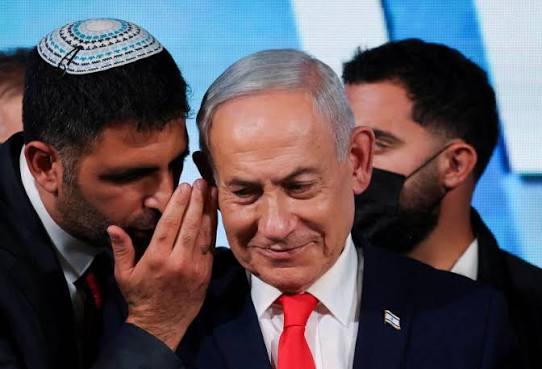
The Palestinian-Israeli Joint List has expressed its willingness to partner with Jewish-Israeli opposition parties to form an alternative government and remove Prime Minister Benjamin Netanyahu from office, following a strong performance in Israel’s parliamentary election.
The alliance, which brings together several Arab-majority parties, has emerged as a significant force in the 120-member Knesset, with the latest reported figures placing it at 13 seats. The results could make the Joint List an important player in negotiations over the formation of the next government.
According to the reported results, Netanyahu’s Likud party has secured 27 seats, while Gadi Eisenkot’s Yashar party has won 20. The Joint List is followed by Naftali Bennett’s Together party, which has 11 seats.
Joint List chairman Yousef Jabareen called for a genuine partnership between Jewish and Arab citizens, saying cooperation was necessary to replace Netanyahu’s government.
Jabareen described the current administration as a “government of bloodshed” and said any political formation seeking an alternative government would need to engage with the Joint List.
The alliance’s performance reflects increased support among Palestinian citizens of Israel, who make up approximately 20 per cent of the country’s population. The group has gained ground amid concerns among some voters over policies they consider discriminatory under Netanyahu’s right-wing government.
Yair Golan, leader of the centre-left Democrats party, has criticised attempts to exclude Palestinian-Israeli parties from negotiations to form the next government.
Golan argued that all Israeli citizens should have equal political representation, regardless of whether they are Jewish or Arab.
“There is one resounding lesson from the reality we face: we have no future here unless we stop being afraid. And unless we put an end to racism,” Golan said.
“We must no longer accept Netanyahu’s racist division between Jewish votes and Arab votes.”
He added that the vote of an Israeli citizen in the Arab town of Tira should carry the same weight as that of a citizen in the Jewish-majority city of Givat Shmuel.
“The vote of an Israeli citizen casting a ballot in Tira is worth exactly the same as the vote of an Israeli citizen casting a ballot in Givat Shmuel. Not less. Not approximately the same. Exactly the same,” he said.
Golan further argued that excluding Arab representatives from government would undermine democratic principles and benefit Netanyahu politically.
“Anyone who tries to erase the votes of Arab citizens is surrendering to Netanyahu and giving up on Israel,” he said.
The Democrats leader maintained that opposition parties had an opportunity and responsibility to form a government that represents all Israeli citizens, including Arab communities.
“I know how to count to 120. Sixty-five is more than 55. That is how Israeli democracy works. Period,” Golan said, referring to the number of seats in the Knesset.
“We have a majority. We have a responsibility. And we have an opportunity to form a change government in partnership with Arab citizens of Israel—a government that serves all Israeli citizens,” he added.
Despite Golan’s position, several parties in the opposition bloc led by Eisenkot have resisted the prospect of forming a government with Palestinian-Israeli parties.
Eisenkot has indicated that cooperation could be possible only if Arab parties recognise Israel as a Jewish state and Hamas as an extremist organisation. Those conditions have complicated efforts to reach an agreement with the Joint List.
The Democrats have so far been among the Jewish-Israeli opposition parties most openly supportive of including Arab representatives in a future government.
Meanwhile, Netanyahu has repeatedly ruled out partnering with Palestinian parties, arguing that such cooperation would be unacceptable. During a speech at his party headquarters, he again rejected the possibility, describing the idea as treasonous.
Political commentator Noa Landau, writing in Haaretz, argued that Eisenkot had “fallen into the trap Netanyahu laid for him over the course of the election campaign,” referring to the opposition leader’s early declaration that he would form a Zionist government.
The debate has also highlighted differences within the political blocs over the role of non-Zionist parties. Netanyahu’s bloc includes ultra-Orthodox Jewish parties that have historically sought exemptions from military service, while the Joint List represents Arab-majority political groups with a distinct position on Palestinian identity and minority rights.
With approximately 70 per cent of votes counted in the figures reported at 11 a.m. local time, Netanyahu’s bloc had 54 seats, while the Eisenkot-led Change bloc held 47 seats. The Palestinian parties, including the Joint List and Ra’am, had a combined 19 seats.
A party or coalition needs at least 61 of the Knesset’s 120 seats to secure a parliamentary majority.
The reported breakdown placed Ra’am, led by Mansour Abbas, at six seats, while the Joint List had 13. The shift has complicated the possibility of the opposition relying exclusively on Ra’am to secure parliamentary support.
Abbas has previously shown greater willingness to engage with Zionist parties, including through the appointment of a Jewish deputy described as Zionist. The Joint List, by contrast, has taken a more assertive position on Palestinian identity and concerns over discrimination against Arab citizens.
The latest figures leave Eisenkot and other opposition leaders facing difficult choices over coalition formation. They could seek an agreement involving the Joint List, attempt to negotiate with other parties, or risk a prolonged political stalemate.
The final outcome will depend on the completed vote count and subsequent coalition negotiations. With neither major bloc reported to have secured the 61 seats required for a majority, the position of the Arab parties is likely to remain central to discussions over Israel’s next government.
Ruto Arrives in Moscow for Russia–Africa Economic Forum, Seeks Trade and Investment Deals

If you like our work, you can buy us a soda
Buy us a soda 🥤