Businessman and former presidential aspirant Jimi Wanjigi has accused the government of harassment and intimidation after alleging that officers from the Directorate of Criminal Investigations (DCI) were deployed outside his Muthaiga residence on Monday, coinciding with nationwide Saba Saba Day protests.
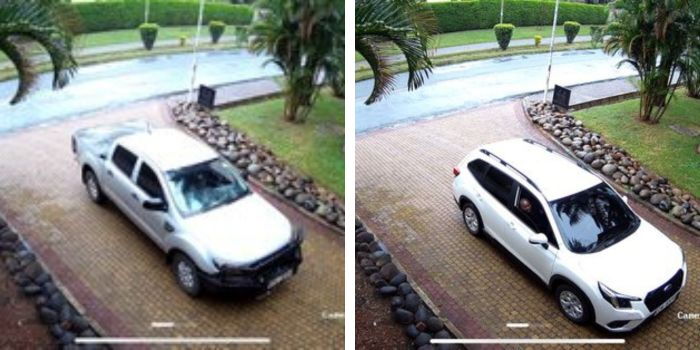
In a statement shared on social media alongside CCTV footage, Wanjigi said two unmarked vehicles—a white Subaru Outback and a grey pickup truck—were seen parked outside his gate on the morning of July 7.
The vehicles, notably bearing civilian number plates, remained in the vicinity for an extended period, raising suspicion.
“DCI at my home today Saba Saba! All this has to stop! Ruto must resign. This intimidation shall not make you legitimate—the people ousted you a long time ago!” Wanjigi wrote in a fiery post on X (formerly Twitter).
Wanjigi, a vocal critic of President William Ruto’s administration, linked the alleged surveillance to ongoing anti-government protests organized to commemorate Saba Saba Day, a date historically associated with calls for democratic reforms in Kenya.
This is not the first time Wanjigi’s Muthaiga home has drawn police attention.
On August 8, 2024, his residence was surrounded by armed officers under what he described at the time as a “targeted political raid.”
In that incident, witnesses reported a black vehicle arriving moments before the police, whose sudden and forceful presence alarmed Wanjigi’s family.
“It’s not shocking. It’s not the first time we have been raided. It seems whenever we are a threat to them, they decide to raid us,” Wanjigi’s son told reporters at the time.
Monday’s incident, however, struck a particularly tense chord given its timing with the Saba Saba protests, which have swept across major towns with demonstrators demanding accountability, lower living costs, and electoral reforms.
While Wanjigi accuses the government of intimidation, scenes across the country reveal a nation under pressure.
Youth-led demonstrations in towns like Kitengela and Kisii overcame police barricades despite a heavy deployment of security forces.
Roadblocks intended to prevent access to central areas were reportedly breached by determined protestors in multiple locations.
The growing unrest appears to have rattled political leaders, with government officials now issuing fresh threats against protest organizers.
In a statement on Sunday, Kapsaret MP Oscar Sudi warned that anyone found to be funding or facilitating protests—including former Deputy President Rigathi Gachagua—would face arrest.
“I see Gachagua inciting and telling people that the President is calling for the apprehension of some people.
But these were the financiers, and you were one of them. And I want to tell you that after apprehending all of them, we will come for you,” said Sudi.
The remarks have further deepened speculation about internal rifts within the Kenya Kwanza coalition and intensified fears of political reprisals against dissenters.
As of publication, the Directorate of Criminal Investigations has not publicly commented on Wanjigi’s allegations.
Civil society organizations and human rights groups are now calling for transparency and adherence to constitutional rights, warning against the use of security agencies to settle political scores.
With the country already on edge, Monday’s events at Wanjigi’s home have added to the growing narrative of a government increasingly accused of cracking down on opposition voices through covert and overt means.

If you like our work, you can buy us a soda
Buy us a soda 🥤