
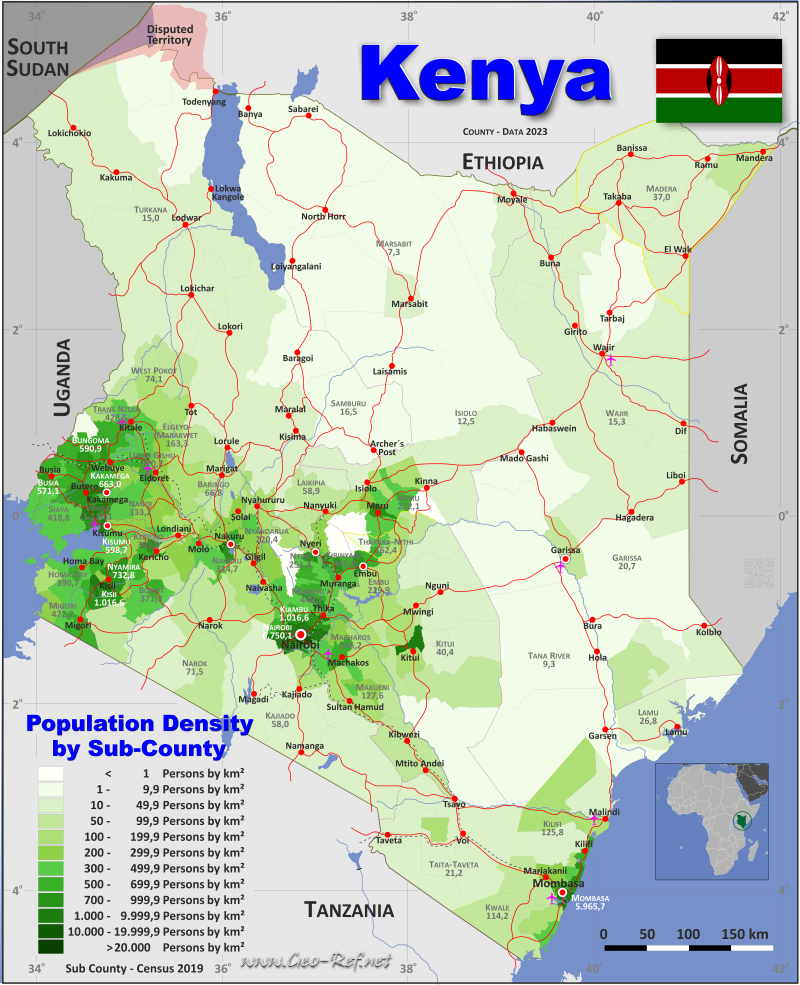
Kenya, covering approximately 582,646 square kilometres, is strategically positioned on Africa’s eastern coastline.
Situated between latitudes 4° North and 4° South, and longitudes 34° East and 42° East of the Greenwich Meridian, the equator bisects the nation almost equally.
The country shares its borders with five neighboring countries—Somalia to the east, Ethiopia to the north, South Sudan to the northwest, Uganda to the west, and Tanzania to the south.
To the southeast, Kenya is flanked by the Indian Ocean, with a coastline stretching about 536 kilometres.
Kenya’s topography is strikingly varied. Its lowest point lies at sea level along the coast, while the country’s highest elevation is Batian Peak on Mount Kenya, which rises to 5,199 metres above sea level.
Over 80 per cent of Kenya’s landmass is classified as arid or semi-arid, predominantly located in the northern and eastern regions.
The more fertile and arable parts of the country lie in the central and western areas, supporting the agricultural economy and accommodating most of the population.
One of the country’s most notable geographic features is the Great Rift Valley, part of the larger East African Rift system, stretching from Mozambique through Kenya to Ethiopia.
Additionally, Kenya boasts significant water bodies such as Lake Victoria—the world’s second-largest freshwater lake—and Lake Turkana, the largest desert lake globally.
The country’s water resources are composed of both surface and groundwater, including rivers, lakes, reservoirs, swamps, dams, and water pans.
Major water catchment areas include the Rift Valley Basin, Tana Basin, Athi Basin, and the Lake Victoria North and South Basins, among others.
Administratively, Kenya operates as a unitary state with a devolved system of governance introduced under the 2010 Constitution.
The country comprises 47 counties, each governed by semi-autonomous local governments.
These counties are subdivided into smaller administrative units such as sub-counties, divisions, locations, and sub-locations.
Power is shared between the national and county governments, facilitating local governance and service delivery.
Kenya’s cultural and religious diversity is a defining feature of the nation, underscored by constitutional provisions promoting cultural heritage and expression.
The country’s more than 40 ethnic communities contribute to a vibrant cultural mosaic, reflected in its wide range of traditions, languages, and religious practices.
English and Kiswahili are the official languages, while Christianity and Islam are the predominant religions.
The nation is also home to many foreign nationals, further enriching its multicultural landscape.
Kenya has experienced remarkable population growth over the past six decades. In 1962, the population stood at 8.6 million.
By 2019, it had surged to 47.6 million, marking more than a fivefold increase. Projections estimate the population to reach 52.4 million by 2024.
This growth is driven by a high total fertility rate (TFR) of 3.4 and a predominantly youthful population, with about 76 per cent under the age of 35.
The annual population growth rate currently stands at approximately 2 per cent.
Demographic shifts have also been noted in the population’s age distribution.
Between 1969 and 2019, the proportion of children under 15 years declined from 48 per cent to 39 per cent.
Meanwhile, the working-age population (15–59 years) increased from 46 per cent to 55 per cent, signaling a demographic transition with potential economic implications.
The share of older persons (60 years and above) has remained relatively stable, fluctuating between five and six per cent over the decades.
These statistics, as detailed in the Kenya Vital Statistics Report 2024, provide essential insights into the country’s geographic, administrative, cultural, and demographic profile—crucial data for planning, policy-making, and national development.