

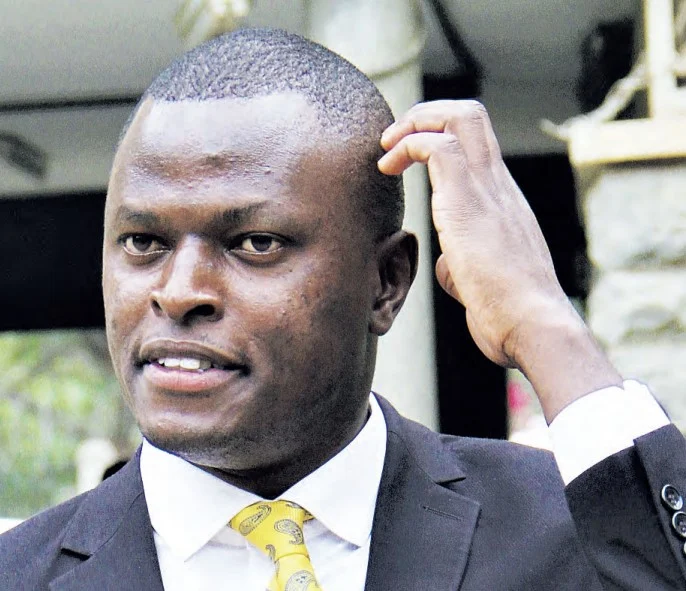
Kiharu MP Ndindi Nyoro has been barred from parliamentary business for five sitting days after refusing to withdraw controversial allegations surrounding the purchase of Kenya Pipeline Company (KPC) shares by state-linked institutions.
The dramatic confrontation in the National Assembly has reignited questions about political influence, the management of public funds and the government’s controversial KPC privatisation process.
Nyoro refuses to apologise
The dispute erupted after Nyoro alleged that senior officials at public institutions were pressured to invest in KPC during the company’s Initial Public Offering (IPO).
According to the legislator, officials at the National Social Security Fund (NSSF), Public Service Superannuation Fund (PSSF) and Kenya Re received phone calls from what he described as the “high office”, allegedly urging them to participate in the share sale.
Nyoro maintained that the investments were politically influenced and questioned why institutions entrusted with public and pensioners’ money would allegedly be directed to purchase the shares.
When challenged to substantiate the claims, the Kiharu MP requested additional time to present evidence.
However, he refused to apologise or withdraw his remarks.
“What I stated is the truth, and the truth rises higher than the rules,” Nyoro said.
His refusal put him on a collision course with National Assembly Speaker Moses Wetang’ula.
Wetang’ula subsequently ruled that Nyoro had engaged in grossly disorderly conduct and ordered that he be excluded from parliamentary business for five sitting days.
Speaker rejects Nyoro’s request for more time
The Speaker’s position was that the controversial remarks had already been expunged from the official parliamentary record, leaving Nyoro with nothing to substantiate within the proceedings.
Wetang’ula told the MP that he could attend Parliament but would not be permitted to participate in debates or transact parliamentary business until he apologised.
The Speaker invoked Standing Order 107, which allows disciplinary action against a member whose conduct is deemed grossly disorderly. The rules provide for exclusion from the precincts of the Assembly for between five and 28 days.
Nyoro, however, remained defiant.
Rather than backing down, he argued that the controversy was about more than parliamentary procedure and insisted that public institutions should make investment decisions independently rather than following political instructions.
Nyoro doubles down after suspension
Speaking after the ruling, Nyoro described his suspension as unfortunate and insisted that his concerns about the KPC investment remained valid.
He argued that NSSF, PSSF, Kenya Re and other institutions should be allowed to make investment decisions based on professional assessments rather than political influence.
The MP also pointed to the performance of KPC shares as part of his argument, claiming that the stock was trading around Sh9.02, barely above the Sh9 IPO price.
He argued that with inflation running at about 6%, such a return represented a poor outcome in real terms.
Nyoro vowed to continue scrutinising how public resources are handled, signalling that the confrontation may not end with his five-day suspension.
The KPC IPO controversy
The row comes months after the government floated part of its stake in Kenya Pipeline Company through an IPO.
The official KPC IPO notice shows that 11.812 billion ordinary shares were offered at Sh9 per share. The offer opened on January 19, 2026 and closed on February 24, 2026.
KPC is considered a strategic state corporation because of its role in transporting and storing petroleum products in Kenya and the wider region.
Parliament had previously backed the company’s privatisation while setting conditions around government ownership, valuation, liabilities and the use of proceeds from the transaction.
Among the issues highlighted by Parliament were pending lawsuits, compensation claims and other liabilities that needed to be properly reflected in the company’s valuation.
IPO struggled to attract some investors
The KPC share sale had already generated debate over investor appetite.
Parliamentary debate earlier this year highlighted weak subscription levels among several categories of investors.
A contribution in the National Assembly cited very low participation by foreign investors, KPC employees, oil marketing companies and retail investors.
The same debate questioned whether the timing of the sale was appropriate given prevailing market conditions.
That background has added weight to the political argument surrounding Nyoro’s allegations.
The government, however, has maintained the broader strategy of using proceeds from asset sales and privatisation to support infrastructure financing.
The latest development comes as Kenya’s National Infrastructure Fund begins deploying its Sh340 billion seed capital, with Reuters reporting that the money originated partly from the privatisation of Kenya Pipeline and the partial sale of Safaricom shares.
Political battle over public money
At the centre of the dispute is a much bigger question: who should determine how billions of shillings held by public institutions are invested?
Nyoro’s allegations, if substantiated, would raise serious questions about the independence of public investment decisions.
But the allegations have not been established in the parliamentary proceedings, and Nyoro’s opponents have demanded evidence.
Majority Leader Kimani Ichung’wah challenged Nyoro to provide proof and defended the KPC investment.
Ichung’wah argued that the PSSF investment had generated a 5.1% gain by the end of June and warned that Nyoro’s allegations could unfairly damage the reputation of professionals working in public institutions.
The confrontation therefore pits two competing arguments against each other: Nyoro’s insistence that Parliament must aggressively scrutinise public investments, and the government’s position that serious allegations made on the floor of the House must be backed by evidence.
Suspension unlikely to silence Nyoro
Rather than ending the controversy, Nyoro’s suspension could give the issue even greater political visibility.
The outspoken MP has already positioned himself as a critic of decisions involving the management of public assets and has previously raised concerns about the timing and structure of government divestments.
His latest clash with Parliament could therefore become another chapter in the increasingly heated debate over privatisation, public investment and political influence in Kenya.
For now, Nyoro remains barred from participating in parliamentary business for five sitting days unless he changes his position and apologises.
But his central question remains hanging over the KPC saga: were public institutions investing because their professionals considered the shares a sound opportunity, or because someone in power wanted them to buy?
That question remains an allegation, not an established fact, and the evidence Nyoro says he can provide will ultimately determine how much weight his claims carry.
FOLLOW NAIROBI NEWS ON FACEBOOK

If you like our work, you can buy us a soda
Buy us a soda 🥤