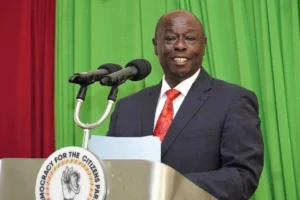

Safina Party leader Jimi Wanjigi launched the party’s offices in Kisumu and Siaya counties, using the occasion to mount a sharp critique of President William Ruto’s administration while rallying support for what he termed an “economic revolution.”
Addressing supporters, Wanjigi said Kenya must move beyond political freedoms and urgently focus on economic empowerment, arguing that many citizens are still unable to meet basic needs such as food, healthcare, and education.
“Political freedom is meaningless without economic progress,” he said. “Economic security is the foundation of dignity, opportunity and hope.”
Wanjigi praised the Luo community as a bastion of democratic struggle, describing it as a region with a long history of fighting for justice and freedom.
He urged unity across the country, saying Kenya’s future depends on collective action to rebuild the economy.
At the same time, he launched a blistering attack on the current government, accusing it of fostering corruption, mismanaging public resources, and plunging the country into unsustainable debt.
“This is a government that cannot guarantee freedom for our people,” Wanjigi said.
“Billions of public money have been lost through corruption and poor policies.”
He positioned the Safina Party as the vehicle for economic transformation, unveiling what he called the “Pesa Fist Agenda,” which he said would end what he termed “debt colonialism” and shift Kenya from a consumption-driven to a production-based economy.
Among the proposals outlined were a simplified tax system capped at 5 percent sales tax, reduced government borrowing, expanded access to affordable credit, and investment in manufacturing and value-added agriculture powered by affordable energy.
Wanjigi also called for the dismantling of ethnic-based politics, saying a new generation of Kenyans—particularly youth—had rejected division in favor of shared economic interests.
“Politics of divide and rule is over,” he said. “All Kenyans are united for their economic and financial security.”
He urged citizens to embrace what he described as bold and sometimes painful reforms necessary to achieve economic independence, create jobs, and improve living standards.
“We are not aiming to survive. We are aiming to thrive,” Wanjigi said, adding that Kenya has the potential to become a beacon of prosperity and innovation.

If you like our work, you can buy us a soda
Buy us a soda 🥤