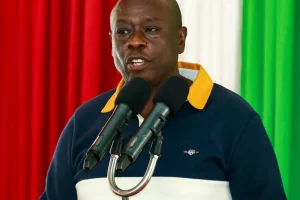

Kericho Governor Erick Mutai has successfully avoided impeachment for the second time in his first term, after the Senate voted on Friday, August 29, 2025, following a three-day plenary session.
The majority of senators concluded that the Kericho County Assembly had failed to meet the required threshold of 32 votes for the governor’s removal.
In the vote, 26 senators determined that the impeachment vote was insufficient, while 16 voted in favor, and one senator abstained.
Impeachment Charges
Governor Mutai had been accused of three main charges by the Kericho County Assembly:
- Gross Violation of the Law: The governor was alleged to have misappropriated county funds, including sh 85.7 million in fictitious payments between January and July 2025, and condoned the misuse of over sh 351 million in the donor-funded NAVCDP project. It was claimed that procurement laws had been flouted, leading to the delivery of substandard supplies.
- Abuse of Office: Mutai faced allegations of illegal appointments, unwarranted dismissals, irregular staff transfers, and interference with the County Assembly’s oversight duties. His tenure has reportedly seen the dismissal of multiple senior officials without due process, resulting in potential costly legal consequences for the county.
- Gross Misconduct: The governor was accused of bullying, incitement, and unlawful actions, including leading a mob to seize private land in Kericho Town, which was later turned into a dumpsite in defiance of a court order.
Legal Defense
Governor Mutai dismissed the charges during his appearance before the Senate, with his legal team, led by attorney Katwa Kigen, arguing that the County Assembly’s impeachment vote was flawed.
Kigen contended that the voting process lacked transparency and did not meet the constitutional requirement of a two-thirds majority.
“The voting process is not verifiable, and its credibility is questionable. It fails to meet the constitutional threshold, and we ask the Senate to reject the impeachment motion,” Kigen argued.
The defense also raised concerns over the credibility of the electronic voting system used by the County Assembly.
MCA Martin Cheruiyot Kiplagat, a key witness for the governor, testified that 18 members, including himself, abstained from voting due to concerns over the system, which had only been introduced hours before the session. Kiplagat added that, out of the 47 MCAs present, only 29 voted falling short of the necessary two-thirds majority.
However, lawyer Elias Mutuma, representing the County Assembly, dismissed Kiplagat’s testimony, labeling him inconsistent and dishonest.
He pointed to Hansard records, showing that Kiplagat had earlier supported the motion to impeach the governor.
Alfred Korir, the Head of ICT at the County Assembly, defended the electronic voting system, asserting that it was transparent, accurate, and fair.
He noted that the entire process, including the announcement of results, was streamed live on the Assembly’s official social media platforms.
The defense team also brought in cybersecurity expert Okuon Job Oguya, who had conducted an audit of the voting system.
Oguya highlighted several vulnerabilities, including the lack of multi-factor authentication and weaknesses in password management protocols. He argued that these flaws made the system susceptible to security threats.
However, Elisha Ongoya, representing the Kericho MCAs, countered that the technical details introduced by Oguya were not included in the official report and had only been brought up during the Senate proceedings.
To resolve the dispute over the voting process, Philip Irode, Deputy Director of Information Systems and Security at the ICT Authority, was called to testify.
Irode confirmed that the number of MCAs who voted in favor of the impeachment could indeed be verified, based on system logs and event records. He further clarified that no one could vote on behalf of another MCA.
The impeachment motion against Governor Mutai was initially introduced by Sigowet Ward MCA Kiprotich Rogony on August 6, 2025.
Despite the motion passing the County Assembly, the Governor survived his impeachment bid last year after the Senate determined the assembly had failed to meet the required constitutional threshold.
For now, Governor Mutai remains in office, with the Senate ruling that the Kericho County Assembly’s impeachment process did not meet the necessary legal requirements.
Concerns Grow As Mystery Surrounds Disappearance Of Wajir Huduma Centre Official