
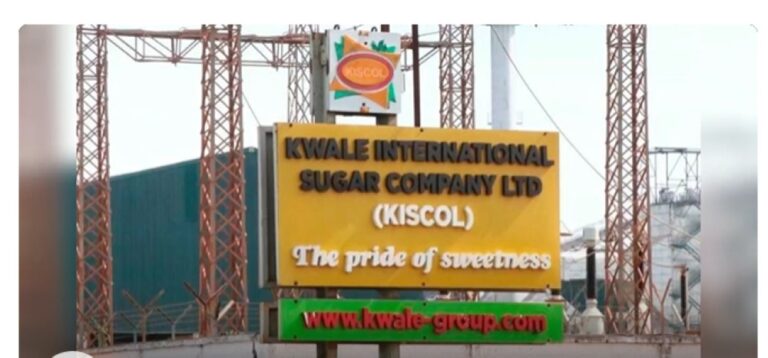
At Ramisi, the future of Kenyan sugar does not need to be imagined.
It is already standing in the green fields and industrial infrastructure of Kwale, where KISCOL was designed to do something unusually ambitious: turn one crop into sugar, electricity, ethanol, jobs, as well as reinvest an entire regional economy.
For years, that promise seemed trapped between disputed land, interrupted operations, and a shortage of cane.
Now the picture is changing.
In July this year, Agriculture Cabinet Secretary Mutahi Kagwe arrived at Ramisi with a message that investors have been waiting to hear: the government intends to stand behind the revival of Kwale International Sugar Company Limited.
He announced a high-level multi-stakeholder committee, led by the Kenya Sugar Board, bringing together national and county governments, investors, farmers, security agencies, and community leaders.
Its objective is practical: resolve the legal, operational, and social obstacles and get the mill fully moving again.
More importantly, Kagwe called KISCOL one of Kenya’s most strategic sugar investments.
That description is not mere ministerial optimism. The numbers support it.
A Rare Asset
KISCOL has a 5,000-hectare nucleus estate, a mill designed to process about 3,300 tonnes of cane a day, and an 18-megawatt bagasse-based cogeneration plant.
It also has an extensive out-grower network and irrigation infrastructure capable of sustaining production beyond the whims of the weather.
That combination is what makes KISCOL different.

A sugar mill without cane is a monument; cane without a dependable mill is a liability.
KISCOL was designed to connect the two.
Walk through a functioning sugar economy, and the factory quickly disappears from view.
What you see instead are tractors, trucks, fertiliser dealers, mechanics, loaders, shopkeepers, and farmers checking their fields.
One tonne of cane does not create value once; it creates a chain of value.
That is why Kagwe’s revival plan matters beyond the factory walls.
Government estimates that reopening KISCOL could restore thousands of jobs, revive cane farming and inject billions of shillings into the coastal economy.
The Bigger Market
There is another reason investors should be watching: Kenya still has a large structural sugar market.
The 2026 Economic Survey reports that domestic sugar production fell to about 613,200 tonnes in 2025, while imports rose to approximately 477,700 tonnes.
That gap is a business opportunity disguised as a national problem.
The country has millions of consumers, established distribution networks, and a large food-processing industry.
It has repeatedly demonstrated that local demand can outstrip domestic supply.
Recent government reforms have begun pushing production sharply higher.
In July, the State said monthly sugar output had risen from about 40,000 tonnes in 2022 to roughly 89,000 tonnes, prompting a halt to sugar imports as local production temporarily exceeded reported monthly consumption.
That development changes the investment equation.
Kenya is no longer simply asking how to rescue sugar factories; it is building a market in which efficient mills can compete for a substantial domestic opportunity.
KISCOL enters that equation with something many greenfield investors would spend years trying to assemble.
The infrastructure exists. Land has already been developed for cane.
Irrigation systems are in place.
The mill and power plant exist, as does an out-grower ecosystem. The challenge is to make the whole machine work together.
Cane Into Gold
And then comes KISCOL’s most interesting proposition: sugar is only one product.
The cane stalk carries several businesses inside it. Its fibre can generate electricity through bagasse cogeneration, while its molasses can support ethanol production.
Irrigation can raise productivity, and processing can stimulate transport, engineering, packaging and logistics.
This is not merely agriculture. It is industrial multiplication.
A field feeds a factory; the factory feeds a power plant; the power plant strengthens the factory; the factory creates a market for farmers; and the farmers sustain the factory.
The circle closes.
That is the sort of integrated industrial thinking Kenya’s sugar sector needs if it is to become internationally competitive.
KISCOL already has much of the architecture.
The opportunity is to finish the building.
FOLLOW NAIROBI NEWS ON FACEBOOK

If you like our work, you can buy us a soda
Buy us a soda 🥤


